Pages

Showing posts with label Flowers. Show all posts

8.01.2016

The Captive V pp 47-64

p 47 | "...yellow dress with big black flowers...": Or maybe the black dress with the big yellow flowers...


p 47 | "... things from Callot's or Doucet's or Paquin's ...": This wonderful page from the Glamour Daze blog should make everything clear.


p 48 | Lady Warwick was Daisy Greville, Countess of Warwick, lover of King Edward VII of England. Not sure which Duchess of Marlborough Oriane is referring to; I like this one, so French!


p 52 | The Galeries Lafayette is an upmarket French department store, founded in 1912. Its flagship store is on Boulevard Haussmann in the 9th arrondissement of Paris.

p 52 | This is a little later than the period the book is in... There is some gay French history on the left side of this page.

p 53 | "Xerxes, son of Darius, ordering..." : After the battle of Salamis, the Persian fleet was destroyed by a storm in the Hellespont. Xerxes, the King of Persia, is said to have vented his feelings by having his servants beat the sea with rods.

p 54 | Social classes in 19th century Paris, with a chronology. A little earlier than the book's time setting. Nicely done.

p 54 | "... Jupien's niece had been, when scarcely more than a child, 'in trouble'..." : Consider these historical notes: 1832 - an age of consent is introduced on 28 April, fixed to 11 years for both sexes.
1863 - Age of consent is raised to 13 years.


p 57 | The House of Croy is an international family of European nobility which held a seat in the Imperial Diet from 1486, and was elevated to the rank of Princes of the Holy Roman Empire in 1594. In 1913 the family had branches in Belgium, France, Austria and Prussia. And the Princes Murat also.

p 59 | hand cramps in violinists -- a real thing!

p 60 | According to this site, before World War I, when France was firmly on the gold standard, a franc was worth about 19 cents, or 5.18 to the dollar. So, 5000 francs at that time would have been about $950. Earlier, it could have been more, so maybe about $1000.
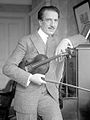


p 63 | Violinist Jacques Thibaud (1880-1953) can be heard here.


p 64 | Syringa is lilac, pronounced like this. Well, seh-RING-gah.

1.31.2016

Sodom and Gomorrah IV pp 542-62


p 543 | cabinet puddings (diplomats) = biscuits soaked in rum or kirsch. See a recipe here.  (Sturrock)

p 549 | La Sanseverina is the spirited, sophisticated heroine of Stendhal's novel La Chartreuse de Parme. (Sturrock)

p 551 | "the Baronne de Rothschild" rose named in 1868 after Laure, wife of Baron Alphonse de Rothschild; "the Maréchale Niel" (actually "Maréchal Niel") pear named in 1864 after Adolphe Niel (1802-69). (Sturrock)

p 555 | Camille Stamati (1811-70), pianist and composer, and teacher of Saint-Saens.


bon Chrétien
p 556-57 | La Comtessed'Escarbagnas is a one-act comedy by Molière, in which the heroine is sent some bon Chrétien pears as a love offering by her suitor, M. Thibaudier. The other pear names that follow came from Elisabeth (not Emilie) de Clermont-Tonnerre’s cookbook, Almanach des bonnes choses de France (1920). (Sturrock)

p 562 | Calvados brandy

5.09.2013

The Guermantes Way III p 366-409

p 371 | ...Voisenon or a Crébillon fils: 18th novelists of licentious fiction; flowers of Fantin-Latour ...

p 372 | Wilhelm von Schlegel (1767-1845), German Romanticist, critic, philologist, and translator; Broglie (a commune in the Eure department in Haute-Normandie in northern France); Marshall Boniface de Castellane; Pierre-Antoine Lebrun (French poet, 1785–1873); Narcisse Achille, Comte de Salvandy ( French writer & politician, 1795–1856); Ximénès Doudan (French journalist, 1800-72); phaeton (carriage);Albertine, Duchesse de Broglie (Mme de Staël’s daughter, 1797-1838)

p 375 | ducal coronet;
p 385 | The statue of Zeus at Olympia by Phidias; 
p 388 |Jules Michelet (French historian, 1798–1874), who first used & defined the word "Renaissance." 
p 389 | Franz-Josef I (Emperor of Austria-Hungary, 1830–1916); Henri V (Comte de Chambord; Pretender to the French throne, 1820–83)
p 391 | Saint-Cyr: convent school near Versailles, founded by Madame de Maintenon in 1686 for young ladies from impoverished noble families. Several of Racine's works were performed there by the pupils.
p 393 |  Édouard Drumont (1844-1917), pamphleteer & journalist, who disseminated anti-Semitic & xenophobic ideas, leading a campaign against Dreyfus based on prejudicial arguments.
p 399 | Condé family in France
p 400 | rent boy: a boy or young man who has sex with other men for money 


From Treharne's footnotes:
p 402 | Droits de l'Homme (Rights of Man): this second league was founded in February 1898 and represented Dreyfusard intellectuals.
p 402 | Jean-Baptiste Billot (1828-1907) was minister of war from 1896 to 1898. 
p 402 | Georges Clemenceau (1841-1929) came to the political forefront thanks to the Dreyfus Affair. Proust is being fanciful about Reinach's influence in these two cases.
p 405 | Fernand Widal (1862-1929), French doctor and bacteriologist
p 407 | The oracular serpent Python was killed by Apollo.
Charcot
p 408 | Jean-Martin Charcot (1825-93) was the founder of modern neurology.  Freud was his most famous pupil. 
p 409 |"People said... go out": an incomplete quotation from Mme de Sévigné's letter to the Comtess de Guitaut, June 3, 1693.

2.07.2013

The Guermantes Way III p 271-298

p 274 |  So what is a Duke, specifically in France?
p 275 |  At-home days
p 276 | The excellent writer G---"...  ; could this be Gide?
p 277 | Adolphe Thiers (French historian, President of the Republic 1797–1877): Prosper    MÉRIMÉE (French novelist, 1803–70); Émile Augier (playwright, 1820­–89): 
p 286 | Vicomte de Borelli, (society poet, late 19th century); Gustave Schlumberger (historian, 1844–1929);  Vicomte Georges d'Avenel (historian & economist, 1855–1939); Pierre Loti (novelist, 1850–1923);  Edmond Rostand  (playwright, 1868–1918, author of Cyrano de Bergerac); Paul Deschanel (French president, 1855–1922); Antonio Pisanello (Italian painter & medallist, c. 1380–1456); Jan Van Huysum (Dutch flower painter, 1682-1749) "... meticulous, dead herbals."

==============================================
mayflowers
apple
cherry


==================================
p 291 | Hera: Greek goddess, Queen of the Olympians
p 294 | Temperature in Mme de V's rooms:  22 C. = 71 F. & 25 C=77 F.
            | Antenor Greek mythological counselor to Priam in the Trojan war; Alpheus = in Greek mythology a river (the modern Alfeios River) & river-god.

4.12.2012

Within a Budding Grove (vol II p 671-77)

p 670 | Sophocles : greatest Greek tragedian, 497 B.C.
  Jean Racine, b. 1639. He was educated at The Petites écoles de Port-Royal, a place of intellectual excellence and educational experimentation.
| Athalie: Racine tragedy 1691.
| Esther: Racine drama 1689.
p 671 | Greek chorus
| Joad (Google translation from the French)
| Robert Garnier, French poet, b. 1544
|Antoine de Montchrestien, b. 1575. Aman = Haman
|Charles Sainte-Beuve, b. 1804, French literary critic; Proust wrote Contre Sainte-Beuve (Against Sainte-Beuve)
|Gustave Merlet, French literary academic, 1829–91.
|Nicolas Deltour, French professor & writer, 1822–1904.
|Edouard Gascq-Desfossé, French textbook author, c. 1886-1909.
p 676 | human life to zoophytes (invertebrate animals that resemble plants, such as sponges, corals and sea anemones)
p 677 | "Harmony in pink and gold": Fictional painting name, but sounds like he's referencing Whistler (surprise!): Finding a parallel between painting and music, Whistler titled many of his paintings "arrangements", "harmonies", and "nocturnes", emphasizing the primacy of tonal harmony. (Wikipedia)
|theogony : description of the creation of the gods.
 
| peacock       or        peony

5.09.2011

Within a Budding Grove (vol II pp 388-94) Notes for May

p 388 | Mme BLANDAIS: wife of the notary from LeMans on holiday at the Grand Hotel.  ... 

...a young page who attracted the eye no less by the unusual and effective colouring of his hair than by his plant-like epidermis. Inside, in the hall, corresponding to the narthex, or Church of the Catechumens in a primitive basilica...(388)
  The narthex of a church is the entrance or lobby area, located at the end of the nave, at the far end from the church's main altar. Catechumen, in the early Church, was the name applied to one who had not yet been initiated into the sacred mysteries, but was undergoing a course of preparation for that purpose. 


p 389 | "...like those pupils of Mme. de Maintenon who, in the garb of young Israelites, carry on the action whenever Esther or Joad ‘goes off.’ (389)
Françoise d'Aubigné, Mme de MAINTENON, (mistress, later wife of Louis XIV, 1635-1719)

Boys of humble background might become pages, or apprentice footmen. Unlike the hall boys, who did heavy work, these pages performed light odd jobs and were liveried when the aristocrat was entertaining.

...The arborescent page... (389)  arborescent:  Like a tree in structure, growth, or appearance; branching. About 1675, from Latin arborescens, present active participle of arboresco (“become a tree”). All one image: he's set on "alien soil" witn a "vegetable immobility."
Apple tree in bloom
"...I sought to carry them back in my imagination to that roadside, to multiply them, to spread them out, so as to fill the frame prepared for them, on the canvas, all ready, of those closest to the outline of which I knew by heart, which I so longed to see—which one day I must see again, at the moment when, with the exquisite fervour of genius, spring was covering their canvas with its colours..." (390)

..."sun radiant" ... ("soleil rayonnant", 390) : quoting Baudelaire's Chant d'automne (Song of Autumn)

... Leconte de Lisle's beautiful image of birds & boats (391), from the Oresteia of Aeschylus.

...The church at Carqueville, "quite buried in its old ivy" (391-2) is based on the church at Criqueboeuf. Another picture is here.
 
 Mme de Villeparisis paints flowers in watercolor (392), as did Proust's great friend & benefactor, Madeleine Lemaire.  She illustrated Proust's book of stories, arranged introductions, and invited him to her salon. 

... the conversational talent of Louis-Philippe...( 394). Wiki.  His museum.