Pages

Showing posts with label Characters. Show all posts

3.25.2017

The Captive V pp 391-403

p 395 | Michelangelo di Lodovico Buonarroti Simoni (1475–1564) was an Italian sculptor, painter, architect, and poet of the High Renaissance who exerted an unparalleled influence on the development of Western art.

p 395 | Pope Leo X (1475–1521), born Giovanni di Lorenzo de' Medici, was Pope from 1513 to his death in 1521. The 2nd son of Lorenzo the Magnificent, ruler of the Florentine Republic, he was elevated to the cardinalate in 1489.p396  |  jarniguié ?
 396  |  friend of the actress" , little society of four friend
from 1788
p 397 |  25 louis:  Louis, also called Louis d’or,  gold coins circulated in France before the Revolution. The franc and livre were silver coins that had shrunk in value to such an extent that by 1740 coins of a larger denomination were needed.  The French kings therefore had gold coins struck and called after their name Louis, or louis d’or (“gold Louis”). After the Revolution, Napoleon continued the practice, calling coins napoleons, valued at 20 francs.

p 398 |  Maurice Barrès (1862–1923) was a French novelist, journalist and politician. He became a figure in French literature with the release of his work The Cult of the Self in 1888. In politics, he was first elected to the Chamber of Deputies in 1889 as a Boulangist and would play a prominent political role for the rest of his life (anti-Dreyfusard).

p 398 | Urbain Le Verrier (1811–77) was a French mathematician who specialized in celestial mechanics & is best known for predicting the existence and position of Neptune using only mathematics.

p 398 | Léon Daudet (1867—1942), French journalist and novelist, the most virulent & bitterly satirical polemicist of his generation in France, whose literary reputation rests largely on his journalistic work & memoirs. Son of novelist Alphonse Daudet, his younger brother Lucien was Proust's friend. Léon's major journalistic achievement began in 1908, when he and Charles Maurras refashioned L’Action française into a daily paper of avowedly reactionary, nationalist, & royalist opinion. Daudet had published an antirepublican satire, Le Pays des partementeurs, in 1901, and his contributions to L’Action française showed the same satirical and Rabelaisian flavor. (Britannica, 1998)

p 398 | Percent of homosexuals (Charlus says 7 out of 10 or 70%). But...According to a study from the National Bureau of Economic Research, about 20 % of the population is attracted to their own gender. That’s nearly double the usual estimates of about 10%. (2013) France in 2015, is probably the least tolerant gay culture country in the list but it has numbers that are likely to surprise you. 1 out of every 10 men in France happens to be gay.

p 399 | Jacques-Bénigne Bossuet (1627–1704) was a French bishop and theologian, renowned for his sermons...He has been considered as one of the most brilliant orators of all time & a masterly French stylist. Court preacher to Louis XIV of France, Bossuet was a strong advocate of political absolutism & the divine right of kings. He argued that government was divine and that kings received their power from God. He was also an important courtier and politician.

p 402 | Amanien, Marquis d’Osmond: This character, nicknamed Mama, was the cousin of the Guermantes who was dying back at III 788-93 & 805-8, which disturbed the Duc & Duchesse's social plans.

p 402 | Pierre de Verjus, Comte de Crécy (Odette’s first husband): Marcel befriends him at Balbec at IV 657-61.
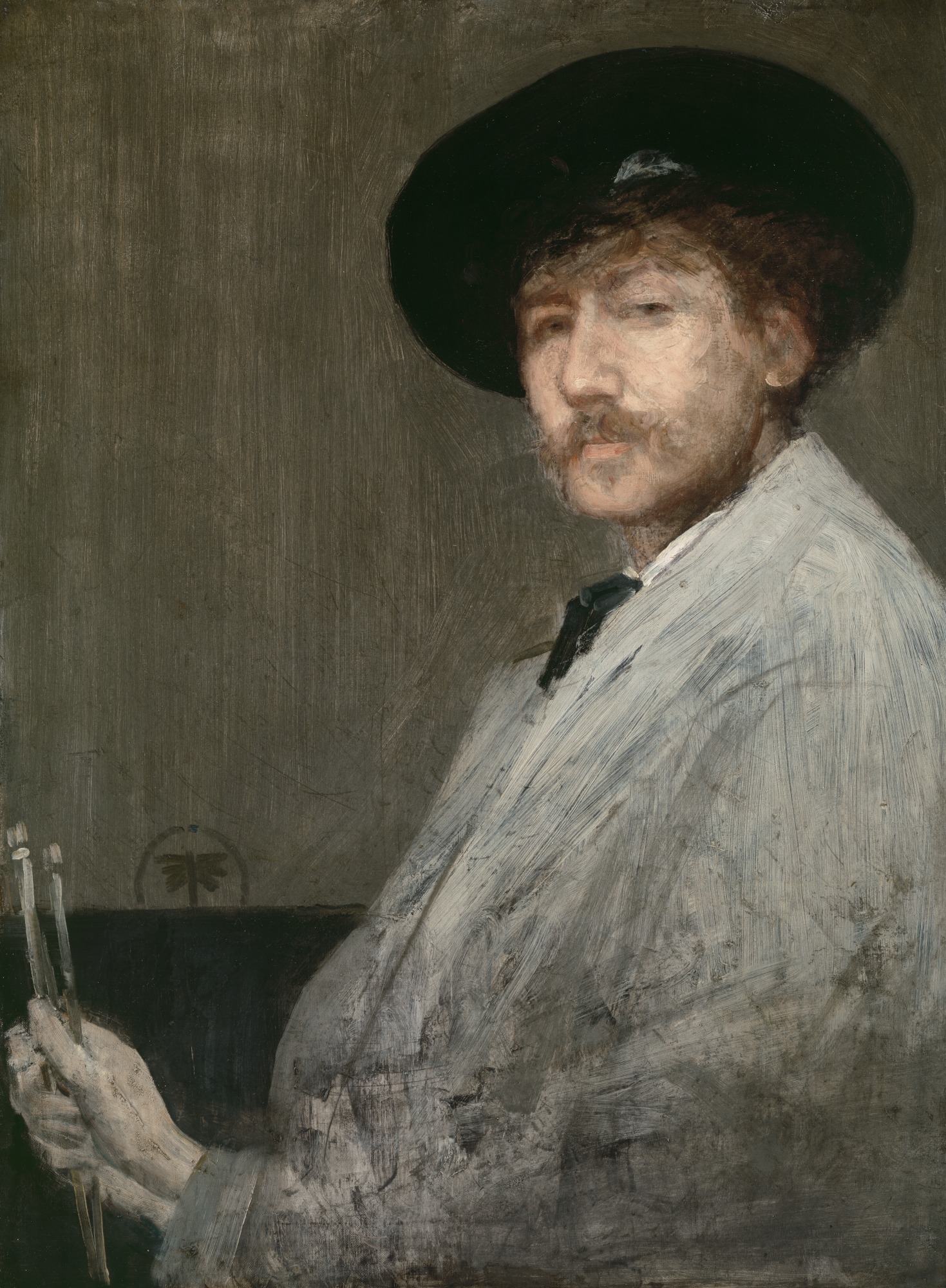

Self Portrait c 1872
p 403 | James McNeill Whistler (1834–1903) was an American artist, active during the American Gilded Age and based primarily in the U.K. He was averse to sentimentality and moral allusion in painting, & was a leading proponent of "art for art's sake." His signature was the shape of a butterfly with a long stinger for a tail, symbolizing both his delicate art and combative public persona. Parallelling painting and music, Whistler titled many of his paintings "arrangements", "harmonies", and "nocturnes", noting the primacy of tonal harmony. His most famous painting is "Arrangement in Grey and Black No. 1" (1871), commonly known as Whistler's Mother. Whistler influenced the art world and the culture of his time with his artistic theories and friendships with leading artists and writers.


Harmony in Pink and Grey: Portrait of Lady Meux

8.05.2016

The Captive V pp 64-83

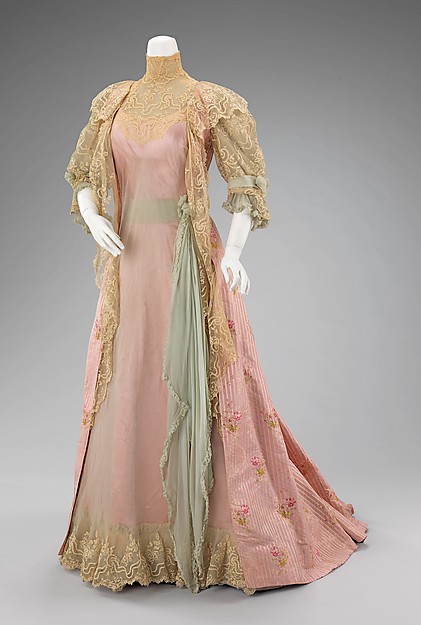
Tea-gown
p 70 | Chinchilla toques with big grey veils are hard to find online. Here's a brief history of women's hats.

p 71 | "...young man so learned in matters of racing..."  This is OCTAVE, the young golfer at Balbec, nephew of M. Verdurin.

p 75 | Mme Swann's tea-gowns would look very much like this.

Click here to see a sampling of the Met's collection of clothes made by Callot Soeurs, which is what the Duchesse was wearing and the Narrator was learning about. 

p 78 | The terrifying jumping girl of Balbec was Andrée (seeWithin a Budding Grove, II p. 508).

p 82 | Tamarisk  The genus Tamarix (tamarisk, salt cedar) is composed of about 50–60 species of flowering plants in the family Tamaricaceae, native to drier areas of Eurasia and Africa.

p 83 | "...figures by Benozzo Gozzoli against a greenish background.."  possibly from the Medici family's Magi Chapel in Florence.


Robe du soir Doucet, Paris, 1900-1905


6.02.2016

The Captive V pp 27-46

p 30 | Elysium (or the Elysian Fields), in Greek mythology, the final resting places of the souls of the heroic and the virtuous. It was ruled by Cronus.

p 30 | My landlady, Mme de Guermantes:  Having originally lived in a different part of Paris, at the beginning of The Guermantes Way, the narrator's family moves to a flat in the Hotel de Guermantes, in the Faubourg Saint-Germain. The side ranges of the front courtyard of the old aristocratic town house are now divided into flats and rented to middle-class families, while the ground floor supports small workshops of various kinds. The furthest range is occupied as a single house by the owners, the Duc and Duchesse de Guermantes, whom by this point in the story the narrator has got to know. Many of the main characters in the story (the narrator, Albertine, the Guermantes, Jupien and his niece) are thus now living on the same site, and can plausibly watch and/or meet each other on the stairs & in the courtyard. Charlus, brother of the Duc de Guermantes, erstwhile sexual partner of Jupien & protector of his niece, visits them all at this address, which is very convenient for the novelist's purposes, and not implausible; such multiple uses of old aristocratic dwellings was common in Paris throughout the 19th century, and its traces can still be seen in the Marais district, until its recent renovation.

p 31 | Carrying an umbrella was, in the 19th & early 20th centuries, a symbol of bourgeois status. Aristocrats were supposed to ride in carriages, poor people to get wet. Louis-Philippe, the 'Citizen King', was often caricatured with an umbrella in his hand.

p 32 | See a selection of early 20th century women's dresses

p 34 | Fortuny's Delphos gown --> 

Delphos
p 35 | Maurice Maeterlinck, Belgian writer, 1862-1949;  Prosper Mérimée, French author, 1803-70.  Paul-Louis Courier, French scholar, 1772-1825)

p 38 | Pampile:  pen-name of Mme Leon Daudet, wife of Proust's friend and author of Les bons plats de France: cuisine régionale (1913).

p 41 | coup d'éclat=feat or great feat; coup de tête=whim; coup de force = a sudden, violent act; rapprochement=establishment or resumption of harmonious relations, reconciliation

p 42 } The Dreyfus affair was a political scandal that from its beginning in 1894 divided France until it was finally resolved in 1906. [So, we think it's 1908-ish here in the text.]

p 44 | In the Aeneid, Achates ("good, faithful Achates", fidus Achates as he was called) was a close friend of Aeneas; his name became a byword for an intimate companion.

p 45 | Mayer Alphonse James Rothschild (1827-1905)

p 46 | Jupiter Tonans = Thundering Jove:  the aspect of Jupiter (Jove) who is the god of sky & thunder and king of the gods in ancient Roman religion & mythology. Here, it refers back to Basin knitting his Jupiterian brows on p 44.

p 46 | Édouard Adolphe Drumont (1844–1917) was a French journalist and writer. He founded the Antisemitic League of France in 1889, and was the founder & editor of the newspaper La Libre Parole.


4.07.2016

Sodom and Gomorrah IV pp 639-662

p 638 | Tantus ab uno splendor = Such brilliance coming from one person. 

p 639 | Mort m'est vie = Death, to me, is life.


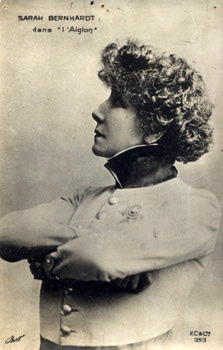
p 639 | In 1900, Sarah Bernhardt created the title role in Edmond Rostand's successful L'Aiglon. Jean-Sully Mounet (1841-1916), called Mounet-Sully, played Oedipus in the Roman arena at Orange (not Nîmes).


p 640 | ...contre-de-quartes reminiscent of Molière: referring to the fencing lesson in Le Bourgeois gentilhomme, a contre-de-quarte is a circular parrying movement of the sword.
 
p 643 | Mazagran = coffee laced with rum; gloria = a mixture of sweet coffee & rum or eau-de-vie.  Eugène Marin Labiche, French dramatist, 1815-88.  Os homini sublime dedit coelumque tueri:  "He has given man a face turned toward the sky," a line from Ovid's Metamorphoses.


p 644-45 | ...Archangel Raphael ... Tobias: this story is in the book of Tobit, in the Apocrypha.

p 657 | Verjuice = the juice from unripe grapes.


p 659 | Constant Coquelin, known as Coquelin aîné, a well-known actor (1841-1909).

p 660 | The Société des Bibliophiles Français was founded in 1820 of mainly aristocrats; the Union Club was founded in 1828 and was the most exclusive Paris club during the Second Empire.

p 661 | The Montgomery & Pembroke families were associated, as were the Chandos family & the Buckinghams. A Capel became Count of Essex in 1661, and Proust knew Berthe Capel in Paris. The Duc de Berry (1844-1910) was a member of the Orléans family.   

p 661 | Émilienne d'Alençon (Émilienne Andrée) was a celebrated courtesan around 1900, who dabbled in music & poetry & appeared with performing rabbits at the Folies-Bergère.

>p 661 | Ne sçais l'heure = I don't know the hour (of my death). It's pronounced like the name Saylor.

p 662 | Jean-Alexis Périer (1869-1954) created the role of Pelléas in Debussy's opera in 1902.  The Théâtre du Gymnase specialized in comedy; La Châtelaine was a comedy by Alfred Capus (1858-1922), a dramatist & journalist who was elected to the Académie Française in 1914.  Simone Frévalles, actress in La Châtelaine , as well as the company at the Théâtre de la Porte-Saint-Martin.  Marie Magnier (1848-1913) made her debut in 1867 and played in many Paris theaters; Louis Baron (1870-1939), known as Baron fils to distinguish him from his actor father, was a well-known comic actor at the turn of the century.

p 663 | Yvette Guilbert (1867-1944) began her celebrated career as a chanteuse around 1885. Ernest Cornaglia (1834-1912), an actor who joined the company at the Théâtre de l'Odéon in 1880; Émile Dehelly (1871-1969) debuted at the Comédie-Française in 1890.

N.B. All entries based primarily based on Sturrock's notes.

3.06.2016

Sodom and Gomorrah IV pp 611-625

p 612 | "Esther heureuse...": the titles of three of the four sections of Splendeurs et misères des courtisanes.

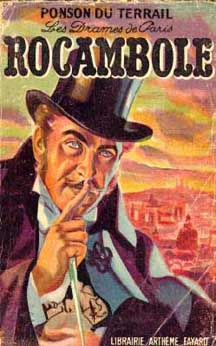
p 612 | Rocambole was the hero of more than 30 adventure novels written by Alexis Ponson du Terrail (1829-71), as well as later writers. The adjective rocambolesque usually means a fantastic adventure.

p 612 | "...moult sorbonagre, sorbonicole et sorboniforme...": a scathing Rabelaisian way of referring to a pedantic doctor from the Sorbonne, perhaps translatable as "Sorbonnified, Sorbonniculous, and Sorbonniform."

p 612 | "The quart d'heure de Rabelais...": popular phrase meaning "the moment of reckoning." An explanatory  anecdote  from a comic incident from the writer’s life. "One day he was in Lyon and wanted to travel to Paris. He had no money and so he marked several sachets of sugar “Poison for the King” and left them lying prominently around. He was arrested and taken to Paris, thus getting a free ride. King Francis I laughed so hard when he heard about it that he happily paid for the trip." Literally, "the quarter-hour of Rabelais," which is amusingly echoed in Andy Warhol's "15 minutes of fame."

p 613 | "Chateaubriand aux pommes": Sturrock says this is "Chateaubriand steak served with apple," but I think the dish is really served with potatoes (pommes frites, pommes de terres...).

p 613 |  gnōthi seauton : Greek for "Know thyself."

p 613 | Jean-Martin Charcot, 19th century French neurologist.

p 614 | "...holy terror Ovid..." Ovid wrote "Materiam superabat opus" (Metamorphoses II, 5), or "The workmanship surpassed the material" (form over content).

Hanska by Delmont
p 614 | "Meudon... ": Meudon, now part of Paris, was the parish of which Rabelais was the curé; Ferney was the Genevan home of Voltaire; the Vallée-aux-Loups, near Sceaux, was where Chateaubriand lived for several years; Les Jardies was the name of Balzac's house in Villa d'Avray; the "Polish woman" was Mme Hanska, whom Balzac married in 1850, shortly before his death and the inspiration for many of his characters. (Sturrock)

p 614 | Hippolyte Taine complained in a well-known essay on Balzac, that the Comedie humaine contained too much that was morbid or unnatural, and did not meet his literary concepts of   "race, milieu, et moment." See his Wiki page for an interesting explanation.

p 617 | Zénaïde, French form of Zenaida, a feminine form of "Zeus."

p 618 | Diane de Maufrigneuse, main character in Balzac's novel Les Secrets de la Princesse de Cadignan, part of the Comedie humaine. 

p 620 | "cut a dash" = (Br.) Be stylish or impressive in one’s dress or behavior, e.g. "The Foreign Secretary wanted to cut a dash in Brussels."

p 620 | Paul Thureau-Dangin (1837-1913) was a Catholic historian, member of the Académie française. Gaston Boissier (1823-1908) was a French classical scholar, and secretary of the Académie française.

p 620 | Boissier is a chocolatier, founded in 1827.

p 621 | ...40bis Boulevard Malesherbes...: For most of his life (until 1900) Proust lived at 9 boulevard Malesherbes, near the Madeleine church, where the family moved in 1873 after his brother Robert was born. Proust himself had lived with his parents at 9 Boulevard Malesherbes.  His maternal grandparents lived at 40bis rue du Faubourg-Poissonniere.

p 621 | Marc-Joseph-Edgar Bourdon Vatry (baron de, 1828-1891)

9.10.2015

Sodom and Gomorrah IV pp 397-446

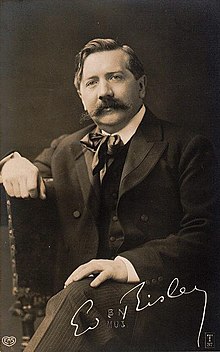
p 401 | Francis Planté (1839-1934), French pianist; Ignacy Jan Paderewski (1860-1941), a virtuoso pianist who twice became prime minister of his native Poland; Édouard Risler (1873-1929), a French pianist best known for his playing of Liszt and Beethoven. 

p 401 | "Qualis artifex pereo!": "What an artist perishes in me!," supposedly the Emperor Nero's last words. German classicists had been unable to agree on the worth or authenticity of the Latin poetry attributed to him. 

p 407 | Demoiselles de Caen (lobsters) are small Normandy lobsters; Pampille was the pen name of Mme Marthe Daudet, who wrote cooking & fashion columns in the right-wing paper L'Action run by her husband, Proust's friend Léon.

p 409 | Pierre de Ronsard (1524-85), greatest of French Renaissance poets. His popularity and prosperity in his own time was steady.   


p 411 | buen retiro: Spanish phrase literally meaning "good retreat", used here meaning toilet.

p 411 | An eminent publisher ... paper knife: possibly a description of Eugene Fasquelle, a Paris publisher known to Proust.

p 419 | Jean-Gilbert-Victor Fialin, Due de Persigny (1808-72), was a right-wing politician who became minister of the interior and ambassador to London under the Second Empire.

p 421 | Dumas fils was Alexandre Dumas (1824-95),  novelist & playwright, son of Alexandre Dumas, the novelist of the same name, best known as the author of La Dame aux camelias.

p 424 | Cancan: the word can refer to either an item of unkind gossip, or the quack of a duck. (mid 19th century: from French, a child's word for canard ‘duck,’ from Old French caner ‘to quack.’ The name can-can may be derived from the French for tittle-tattle or scandal. However the dance was also called the coin-coin, which could have become corrupted into can-can.

p 427 | Jean de La Fontaine (1621-95),  the  greatest  of French  fabulists; Jean-Pierre Claris de Florian (1755-94), Voltaire's great-nephew and, as a writer of fables, much influenced by Rousseau.

p 427 | Julien de Monchateau ... "Pico della Mirandola": Francois de Monchateau was celebrated in France as a child prodigy (as was Pic0 della Mirandola in Renaissance Florence).

p 429 | Place Saint-Sulpice: where, in Paris, the cheapest and most tasteless religious objects can be bought.

p 430 Ferdinand Barbedienne (1810-92) specialized in casting bronze reproductions of classical statuary, popular with 19th-century bourgeoisie.

p 434 | Harpagon: the sexagenarian bourgeois miser in Molière's comedy L'Avare (The Miser).

p 434-37 | "Chantepie ... Does it deserve its name?": une pie is "a magpie," chanter means "to sing," so that the name should refer to a place where magpies sing.

p 438 | Jules Lachelier (1832-1918), French idealist philosopher, wrote influentially about the problem of induction, and is opposed here to John Stuart Mill, a philosopher known
in France in Proust's day as an extreme empiricist.


p 438 | Jean-Francois Millet (1814-75), celebrated for painting scenes of peasant life, notably the much reproduced L'Angelus.

p 439 | Chantereine: play on words... chanter, to sing and reine means "queen."

p 440-41 | Pont-a-Couleuvre would literally mean "Snake Bridge" or “Serpent bridge,” which was formerly Pont-à-Quileuvre, which in old French stands for Pont a qui l'euvre, in Latin Pons cui aperit, i.e., Pont a qui ouvre, closed bridge opened only upon payment.


p 441 | In none of La Fontaine's or Florian's fables does a frog find itself before the Areopagus, or supreme court of Athens.

p 443 | " 'She has good qualities ...'": the quotation from Mme de Sévigné, modified by Proust, refers to her daughter-in-law.

p 446 | Members of the French Senate, like Charles de Freycinet (1828-1923) and Justin de Selves (1848-1934). Sylva = Latin word for a wood.

p 447-48 | The Tour d'Argent, on the Left Bank, was, and is, one of the great restaurants of Paris; the Hotel Meurice, on the rue de Rivoli, was one of the city's best in Proust's day.  Emile Boutroux (1845-1921) taught philosophy at the Sorbonne, and at one time had Henri Bergson for a pupil. 

p 448-49 | The Forty are the "Immortals," or the 40 members of the Academie Francaise. Not all the names Brichot cites were actual Academicians.

p 449 | Paul Parfouru (1842-1917) was called Porel. He was an actor & theater director, who ran the Odéonon theater from 1884 to 1892, hence the reference to "Odeonia"; his son, Jacques Porel  (1893-1982), was a friend of Proust's.

p 449-51 | "...two trees...": Saint-Martin-du-Chene (un chene is an oak tree) & Saint-Pierre-des-Ifs (un if is a yew tree).


Place Saint-Sulpice

N.B. All entries based primarily based on Sturrock's notes.

6.26.2015

Sodom and Gomorrah IV pp 323-342

p 324 | Prothyraia, Hera, Neptune, Nereus, Leto, Protogonos, etc. see, for example, Greek Mythology; styrax; saffron; myrrh; manna; Orphic hymns; Amphietes; Orgiophant

p 325 | Sapphism, derived from Sappho.

p 329 | Esther and Athalie by Jean Racine.
 
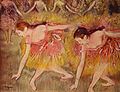
p 329 | Edgar Dégas drew, painted, and sculpted many ballet dancers. 

p 331 | atavism; seraglio; purlieus


p 331 | La Juive (The Jewish Woman): an opera, with music by Fromental Halévy (1799-1862), first performed in 1835.

p 331 | "C'est un courrier de cabinet": popular tune from Les Brigands, an opera by Jacques Offenbach (1819-80). It was the equivalent of a King's or Queen's messenger.

p 331-32 | Céleste Albaret (née Gineste, 1891-1984), married to a taxi-driver employed by Proust, became his housekeeper in 1914 and worked for him until his death in 1922. Her memories were published in 1973 as Monsieur Proust. (See video here.) Marie Gineste, her unmarried sister, sometimes helped; both originally were from Auvergne.


Leger / Perse
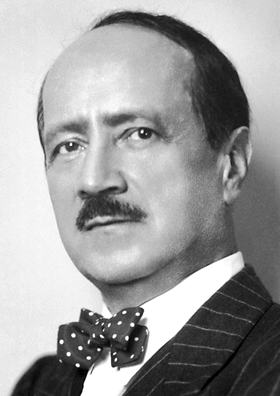
p 336 | Alexis Saint-Leger Leger (1887-1975), French poet and diplomat wrote under the name Saint-John Perse. Éloges appeared in 1911. Real name=Alexis Leger. Nobel Prize for Literature (1960).

p 336 | "Here below the lilacs die..."first line of a poem by Sully Prudhomme (1839-1907), French poet, who received the first Nobel Prize for literature, in 1901. This poem was often set to music. 

p 336 | Archibishop of Tours; Bishop of Rodez.

6.12.2015

Sodom and Gomorrah IV pp 305-323

p 305 | Brief history of tipping, with more here

p 305 | Dinard, France, on the coast of Brittany, Deauville; Balbec=Cabourg (coast of Normandy, on the French side of the English Channel)

p 305 | "on the rocks" ; General de Beautreillis (character)

p 318 | Arabian Nights; the Galland translation appeared in 12 volumes early in the 18th century; the Mardrus appeared between 1899 and 1904, and restored the risqué elements that Galland had censored (Storrock)

p 319 | Augustin Thierry (1795-1856), a medieval historian of Romantic views, who wrote notably about the Merovingians and the Norman Conquest of England. Part of his search for local color involved using the Germanic forms of Merovingian names long since Gallicized by other writers. (Storrock)

p 319 | Carolingians; Merowig

p 319 | Charles-Marie Leconte de Lisle (1818-94), the most prominent of the post-Romantic Parnassian school of poets, who took much of his subject matter from antiquity.

p 319 |Alphonse de Lamartine (1790-1869), the most lyrical and thus least Parnassian of Romantic poets.

p 319 | Characters in the Odyssey 
 
p 323 | Viviane is a good fairy in Chrétien de Troyes's 12th-century romance of Lancelot, who turns the hero into a perfect knight. Puss in Boots is a character in one of Perrault's fairy tales.

6.11.2015

Sodom and Gomorrah IV p 203-245

p 205 | Caen

p 205 | French Legion of Honour
 
p 205 | L'Écho de Paris was a daily newspaper in Paris, 1884 to 1944.

Caillaux
p 205 | Joseph Caillaux (1863-1944), a Radical politician who served as prime minister from 1911 to 1912.

p 205 | "under the thimble ... thumb": the manager says "sous la coupole" instead of "sous la coupe," which improves the joke, since "sous la coupole" refers to the meeting place of the Académie Française (being re­ceived sous la coupole means being elected to the Academy). (Sturrock)


p 210 | M. Paillard was a well-known Paris restaurant, patronized by some of Proust's friends.

From  A Companion to Evelyn Waugh’s Brideshead Revisited: "Paillard’s was one of leading restaurants of Paris... created in 1880 when M. Paillard took over an establishment situated at the corner of the Rue de la Chaussée-d’Antin and the Boulevard des Capucines from the Bignon brothers. According to Larousse Gastronomique, ‘Favourite dishes were chicken Archduke, Georgette potatoes, calves’ sweetbreads with asparagus tips, fillets of sole Chauchat and, above all, stuffed duck, rivalling the duck au sang of the Tour d’Argent.’  The culinary term paillard is of course named after the famous chef, who trained under the great Escoffier himself. It is a thin slice of veal (or now, any meat) pounded even thinner until it is translucent and then grilled or fried for a few seconds only."
p 216 | Lethe: the stream of oblivion & forgetfulness, was one of the rivers of the underworld and its goddess (Greek mythology).
Jammes

p 218 | Francis Jammes (1868-1938) wrote simple poetry, often on the theme of innocence re­covered. The stag in this dream sequence appears to derive from a story by Flaubert, "The Legend of Saint Julien the Hospitaler," in which a stag predicts to Julien that he will kill his father & mother (this reference may be relate to Proust’s guilt about the death of his mother). The fork comes from an earlier draft of the novel, where the sound of a fork striking a plate triggers the Narrator’s involuntary memories (like the madeleine). In the final book (Time Regained), the fork has become a spoon.(Sturrock)  After reading Swann's Way, Jammes wrote Proust a letter comparing him to Shakespeare and Balzac.

p 219 | Aias: Greek for Ajax in the Iliad, who, in his madness killed sheep & shepherds after mistaking them for fellow Greeks. (Sturrock)


p 223 | barouche: carriage

p 223 |Jonathan, i.e., John the Baptist. (Sturrock)
 
p 228 | Duc d’Orléans…: only two of the four separate houses of Orléans ever succeeded to the throne, with the second occasion in 1830, with King Louis-Philippe; the title of Prince de Tarente belonged indeed to the house of La Trémoille.

p 229 |Mme Marie de Sévigné (1626-96), considered to be one France’s greatest letter-writers; Proust admired the quick, spirited impressionism of her style. Mme de Beausergent is a character, not a person.(Sturrock)

p 231-2 | Bertrand de Salignac-Fénélon (1878-1914) was killed in the opening months of WWI. He was descended from a brother of François de Salignac de La Mothe-Fénélon (1651-1715), writer, theologian, Archbishop; also known as the “Swan” of Cambrai, whose Aventures de Télémaque were interpreted as a veiled attack on Louis XIV.< (Sturrock) He was Proust's very good friend and partial model for Saint-Loup.


p 232 | René Duguay-Trouin, Sieur du Guay (1673-1736), a sailor whose statue stands in his native Saint-Malo. (Sturrock)

p 232 | whitlow: an infection of the tip of the finger.

p 234 | The Abbess of Fontevrault was Marie-Madeleine Gabrielle de Rochechouart (1645-1704), who was the older sister of Françoise-Athénaïs de Rochechouart (1640-1707), the Marquise de Montespan, who was the mistress of King Louis XIV

p 235 | Panathenaea: an Athenian festival to honor the goddess Athena, depicted on a frieze on the Parthenon, fragments of which are in the British Museum & the Louvre. (Sturrock)

p 240-1 | syncope ("sincup"): a short loss of consciousness and muscle strength, fainting, passing out.

p 243 | "angel lutanists, Italian cathedral, porphyry, jasper... " maybe Cappella Di San Brizio (Duomo) in Orvieto.