Pages

Showing posts with label Humor. Show all posts

10.30.2016

The Captive V pp 169-210


p 176 | Gregory the Great . . . Palestrina: Gregory the Great, Pope from 590 to 604, is supposed to have set the rules for Gregorian chant. A 16th-century Pope, Gregory XIII, had Palestrina adapt the old chants to the new liturgy of Pius V. (Clark)

p 180 | Charles de Sévigné, son of Madame de Sévigné.

p 185 | Les Fourberies de Nérine, a comedy in verse by by Théodore de Banville


p 195 | Danaides . . . Ixion: From Greek legend, they were condemned to never-ending tasks. The Danaides (the 50 daughters of Danaus) murdered their husbands and were condemned to spend eternity pouring water into a bottomless vessel. Ixion was attached by Zeus to a burning wheel which turned eternally in the Underworld.

p 196 | Trois Quartiers shop in Paris.

p 203 | midinette : Parisian seamstress or salesgirl in a clothes shop (French, from midi [noon] + dinette [light meal], since the girls had time for no more than a snack at midday). © Collins English Dictionary,, 12th ed, 2014

p 205 | Lamoureux concert = an orchestral concert society which once gave weekly concerts by its own orchestra, founded in Paris by Charles Lamoureux in 1881.

p 205 | The Longjumeau Postilion: An 1836 comic opera by Adolphe Adam. In 1915, the critic Frederic Masson wrote that this work compared to Wagner's Die Meistersinger.

p 207 | Human Comedy (title of Balzac's collected novels); The Legend of the Centuries (a collection of narrative poems by Victor Hugo); The Bible of Humanity (imaginative attempt at a synthesis of human history by Jules Michelet)

p 210 | 120 hp Mystère : a make of aircraft.

p 210 | L 'Education sentimentale: in Flaubert's novel of that name, the woman the hero loves sees in his house a portrait of a former mistress of his, whom she had known. She says, "I've seen that woman somewhere," but he replies, "Impossible, it's an old Italian painting."

3.06.2016

Sodom and Gomorrah IV pp 611-625

p 612 | "Esther heureuse...": the titles of three of the four sections of Splendeurs et misères des courtisanes.

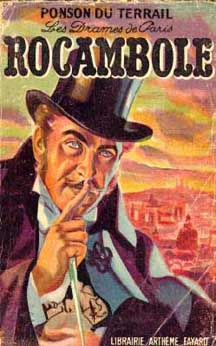
p 612 | Rocambole was the hero of more than 30 adventure novels written by Alexis Ponson du Terrail (1829-71), as well as later writers. The adjective rocambolesque usually means a fantastic adventure.

p 612 | "...moult sorbonagre, sorbonicole et sorboniforme...": a scathing Rabelaisian way of referring to a pedantic doctor from the Sorbonne, perhaps translatable as "Sorbonnified, Sorbonniculous, and Sorbonniform."

p 612 | "The quart d'heure de Rabelais...": popular phrase meaning "the moment of reckoning." An explanatory  anecdote  from a comic incident from the writer’s life. "One day he was in Lyon and wanted to travel to Paris. He had no money and so he marked several sachets of sugar “Poison for the King” and left them lying prominently around. He was arrested and taken to Paris, thus getting a free ride. King Francis I laughed so hard when he heard about it that he happily paid for the trip." Literally, "the quarter-hour of Rabelais," which is amusingly echoed in Andy Warhol's "15 minutes of fame."

p 613 | "Chateaubriand aux pommes": Sturrock says this is "Chateaubriand steak served with apple," but I think the dish is really served with potatoes (pommes frites, pommes de terres...).

p 613 |  gnōthi seauton : Greek for "Know thyself."

p 613 | Jean-Martin Charcot, 19th century French neurologist.

p 614 | "...holy terror Ovid..." Ovid wrote "Materiam superabat opus" (Metamorphoses II, 5), or "The workmanship surpassed the material" (form over content).

Hanska by Delmont
p 614 | "Meudon... ": Meudon, now part of Paris, was the parish of which Rabelais was the curé; Ferney was the Genevan home of Voltaire; the Vallée-aux-Loups, near Sceaux, was where Chateaubriand lived for several years; Les Jardies was the name of Balzac's house in Villa d'Avray; the "Polish woman" was Mme Hanska, whom Balzac married in 1850, shortly before his death and the inspiration for many of his characters. (Sturrock)

p 614 | Hippolyte Taine complained in a well-known essay on Balzac, that the Comedie humaine contained too much that was morbid or unnatural, and did not meet his literary concepts of   "race, milieu, et moment." See his Wiki page for an interesting explanation.

p 617 | Zénaïde, French form of Zenaida, a feminine form of "Zeus."

p 618 | Diane de Maufrigneuse, main character in Balzac's novel Les Secrets de la Princesse de Cadignan, part of the Comedie humaine. 

p 620 | "cut a dash" = (Br.) Be stylish or impressive in one’s dress or behavior, e.g. "The Foreign Secretary wanted to cut a dash in Brussels."

p 620 | Paul Thureau-Dangin (1837-1913) was a Catholic historian, member of the Académie française. Gaston Boissier (1823-1908) was a French classical scholar, and secretary of the Académie française.

p 620 | Boissier is a chocolatier, founded in 1827.

p 621 | ...40bis Boulevard Malesherbes...: For most of his life (until 1900) Proust lived at 9 boulevard Malesherbes, near the Madeleine church, where the family moved in 1873 after his brother Robert was born. Proust himself had lived with his parents at 9 Boulevard Malesherbes.  His maternal grandparents lived at 40bis rue du Faubourg-Poissonniere.

p 621 | Marc-Joseph-Edgar Bourdon Vatry (baron de, 1828-1891)

6.17.2012

9.04.2009

Summarizing Proust

Proustians:  Thank you for coming tonight and making the evening quite special for me. After leaving you, I was so excited, I went to AIA, where there was a perfectly outstanding sunset in mauve reflected on the unmoving ocean, while the great white moon broke through the rain-soaked clouds to cast its shimmering light across the water and up the beach right onto my feet.  I put this sunset moment at the end of all other sunset moments I've had and photographed and, as I often do, judged it the best ever. 

Because I'd fallen asleep before the group, I'd had some caffeine assistance to perk up; I see now that it kicked in just when I needed to lay out the direction your reading could go. Sorry I was so one-track.... more than a little like Monty Python's hilarious Summarize Proust Competition!

I just set up http://readproust.blogspot.com/ == a/k/a "Reading Proust for Fun." You all got invitations to both post and comment. You could use it to save thoughts / sentences / ideas for discussion.  Or if you hate it, I'll close it down.

One thing I meant to mention.... the French title... A la recherche du temps perdu  literally translates into In Search of Lost Time (ISOLT), which was finally used in the Enright translation in 1998. Scott-Moncrieff chose Remembrance of Things Past (RTP), which is not exactly the same idea at all, but is a phrase taken from a sonnet by Shakespeare.  He also named all the other books using Shakespearean phrases, which Proust hated. The latest translations restore the original titles.