Pages

Showing posts with label Furniture. Show all posts

9.29.2015

Sodom and Gomorrah IV pp 456-70

p 456 | Banat;  Louis d'Harcourt; Jean Anthelme Brillat-Savarin, 1755-1826): French lawyer and politician, who gained fame as an epicure and gastronome; sibylline = referring to certain women of antiquity reputed to possess powers of prophecy or divination; a female prophet or witch.

p 457 | Piquet=an early 16th-century trick-taking card game for two players. The river Dives runs through Cabourg (Balbec), this is the church by the river, Notre Dame de Dives sur mer.

p 459 | daubing: to coat or smear (a surface) with a thick or sticky substance in a carelessly rough way. 

p 459 | Paul César Helleu (1859-1927): French oil painter, pastel artist, drypoint etcher, and designer, best known for numerous portraits of beautiful society women of the Belle Époque. He also conceived the ceiling mural of night sky constellations for Grand Central Terminal in NYC. Father of Jean Helleu, grandfather of Jacques Helleu, both artistic directors for Parfums Chanel. 
Jouy

p 460 | French strawberry mousse recipe.

p 463 | See a summary of these pages here, with comments.
 
p 466 | "a piece of green lustre plugging a broken pane...": a drop-shaped piece of cut glass or crystal used as a decoration on a chandelier, vase, etc. Or, a shiny metallic surface on some pottery and porcelain.

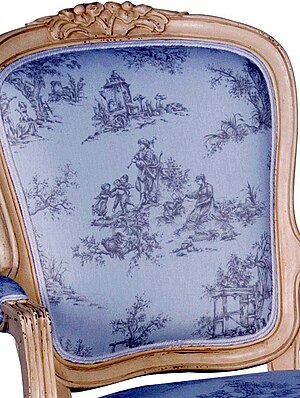
p 467 | Jouy hangings=toile de Jouy: cloth or canvas for painting on. draught-curtains are used to prevent heat loss from a room, due to drafts or weather. 

p 468 | A misericord (sometimes named mercy seat) is a small wooden shelf on the underside of a folding seat in a church, installed to provide a degree of comfort for a person who has to stand during long periods of prayer. The small shelves were available for use at times when the folding chair was required to be stored folded up, and the person expected to be in an upright position.
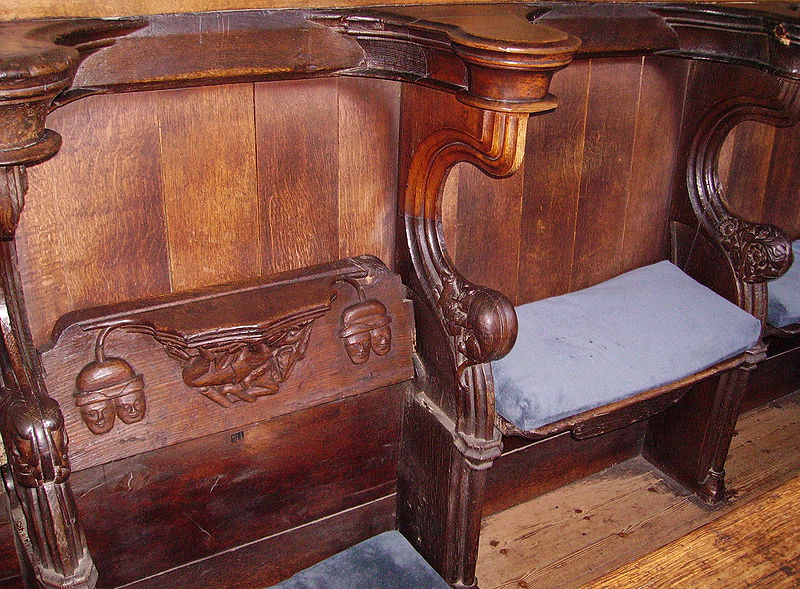
"Boston Stump misericord 02" by Immanuel Giel (Own work). Public Domain via Commons License
 p 468 | Agraphia: loss of the ability to write.

p 470 | "this Hohenzollern ... : with the abdication of Wilhelm II in 1918, the Hohenzollern dynasty of German emperors came to an end. The short-lived kingdom of Hanover was annexed by Prussia in 1866, and its last King was indeed dispossessed, but by Kaiser Wilhelm I, not his son. Prussia annexed Alsace-Lorraine from France following its victory in the 1870 war. (Sturrock)


3.19.2015

Sodom and Gomorrah IV pp 177-95

p 189 | Jojotte...: nickname of portrait painter Georges Clarin (1843-1919), who signed the first petition in favor of Dreyfus, after Zola’s “J’accuse” was published. He frequently painted Sarah Bernhardt. (Sturrock)


Atlantic auger 0008 by Edward T. Babinski
 p 190 | "...crenellated turret of its shell...

p 191 | Cours-la-Reine: avenue that runs along the Seine between the Place de la Concorde and the Grand-Palais. (Sturrock)

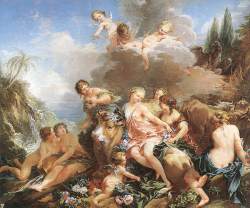
p 191 | "Beauvais armchair illustrating the Rape of Europa...": this chair and this 1747 painting by François Boucher


p 191-2|"... pictures of society...": Does this refer to Proust's first book, Pleasures and Regrets ? (full French text of Les Plaisirs et les Jours is here)

p 193 | The Consulate ran from 1799 to 1804, with Napoleon the de facto ruler of France as First Consul…; the Direc­tory had lasted from 1795 to the coup d’état of November 1799, when Napoleon seized power. The two regimes fostered distinct cultural styles. (Sturrock)


Firebird by Bakst
p 193 |Sergei Diaghilev’s Ballets Russes created a sensation in Paris from their first appearance there in 1909. Léon Bakst (1866-1924) was the foremost designer of their sets and costumes; Vaslav Nijinsky (1890-1950) was the most celebrated Russian male dancer; Alexandre Benois (1870-1960) was a painter who also designed stage sets; Igor Stravinsky (1882-1971) wrote some of his best-known music for Diaghilev, notably The Firebird and The Rite of Spring; Princess Yourbeletieff is an invented character. (Sturrock)


 p 193 | Aigrette (from the French for egret) refers to the tufted crest or head-plumes of the egret, used for adorning a headdress; also, any similar ornament made of gems.

p 194 | Avatar: A temporary manifestation or aspect of a continuing entity, i.e., occultism in its present avatar.

p 195 |"... gimlet eyes of nationalist ladies..." : sharp or piercing, as this tool.

p 195 | While searching for the Princesse d'Epinoy, I found this wonderful essay on nobility and titles in France.

1.16.2015

Sodom and Gomorrah IV pp 119-23

p 119 | la barbe literally, "the beard," an expression meaning "what a drag.” (Sturrock)
p 119 | sphinxes along arms of chairs; see, for example, here.
p 119 | augural: the art or practice of an augur; divination. 2. the rite or ceremony of an augur. 3. an omen, token, or indication. Mid. Eng · Latin. 1325-75. Signifying the future : ominous, portentous, or auspicious.
p 119 | Pythia, oracle of Delphi.
p 120 | more geometrico: in the geometrical mode (Sturrock).
p120 | sibylline: "having a secret meaning" or "foretelling the future," like a fortune teller whose crystal ball reveals a sibylline message about what will happen. If you can predict this meaning, you may come from a family of psychics — or you may have a background in Greek mythology. Origins in the Greek word Sibulla, meaning "prophetess." Back in Greek & Roman times, a sibyl was a female oracle who delivered cryptic prophecies foretelling the future, often inspired by the deities.
p 120 | grimoire: a textbook of magic.
p 120 | children of Jupiter: Metis=first great spouse of Zeus. Themis=one of the first Delphic oracles. Eurynome=3rd bride of Zeus. See also 12 Olympians in the Greek pantheon.
p 121 | "suave, mari magno” (“how sweet when, on the open sea") are the first words of a passage by the Roman poet Lucretius where he reflects on the comfort of watching from the shore as the lives of others are imperiled by a storm out at sea; memento quia pulvis (“remember thou art dust") are words drawn from Genesis 3:19 and God's promise to Adam: "for dust thou art, and unto dust shalt thou return." (Sturrock)
p 121 | punchinello nose 
p 121 | The Valois were the reigning dynasty in France from 1328 to 1589. (Sturrock)
p 123 | camphorate - treat with camphor; subject to a process or treatment, with the aim of readying , improving, or remedying a condition; "process hair," "treat the water so it can be drunk," etc.

5.02.2014

The Guermantes Way III p 703-10

p 704 | King of Spain:  Alfonso XIII, who reigned from 1886-1931.
p 705 | pabululm: bland, simplistic food or intellectual sustenance; sapid=flavorful.
p 705 | The Supreme War Council, founded 1917 in Versailles, was a central command created by British Prime Minister David Lloyd George to coordinate Allied military strategy during WWI. 
p 705 | French in Morocco

p 706 | a purple flower that smells bad.... maybe  Amorphophallus titanum known as the Titan Arum or Datura stramonium, known as Jimson weed or Devil's snare.
p 708 | Edmond Albius (Albins), and vanilla propagation
p 709 | Empire-style furniture 
p 709 | Montesquiou family
p 710 | furniture with a Wedgwood medallion
p 710 | Duc de Guastalla & the Princesse de Parme
p 710 | How Proust knows about Princesse Mathilde & the Duc d'Aumale; interesting write-up about her here on page 464 and following. Here is a painting of her salon. Here's the duke.


11.29.2013

The Guermantes Way III p 498-522

p 502, 506 | Saint-André-des-Champs: Proust's fictional church near Combray, which throughout the novel comes to represent, through its Gothic sculptures of people, the essence of "Frenchness." He has related it to Francoise & Theodore. Here he sees Albertine's little peasant face.
p 503 | Mme. Blandais: minor character, wife of a LeMans notary Marcel meets on holiday at the Grand Hotel.
p 507 | A bergère is an enclosed upholstered French armchair with an upholstered back and armrests on upholstered frames.


p 507 | Yellow satin gown with black poppies... well, maybe something like this (but way nicer...)
p 508 | Schubert's Adieu (music);
"The song is not by Schubert, but by August Heinrich von Weyrauch. It was first published in 1824, to a text by Karl Friedrich Gottlob Wetzel. Schubert's name was first attached to the song in 1843. The author of the French text to which the song is now sung ("Voici l'instant supreme...") is thought to have been Edouard Belanger. (Reed, John. The Schubert Song Companion, page 12, via books.google.com).  (Note that the lines quoted are not part of these lyrics, as far as I can tell.)
p 514-15 | "Fabrice's aunt... Count Mosca": reference to characters in Stendahl's novel The Charterhouse of Parma.
p 517-18 | Book of EstherAhasuerus (later Xerxes) is given as the name of the King of Persia in the Book of Esther; Mordecai was there also.
p 520 | Théâtre-Français = Comédie-Française .
p 520 | Fernand Labori was the lawyer for Dreyfus & Zola.
p 521 | May be Elizabeth, Princess of Ligne.


1.24.2010

Swann in Love (vol I p 265 ff) Notes on week 17 :: Music

Who Wrote Vinteuil's Sonata?
Excellent blog article by Blair Sanderson on which composer's work may have been the model for Vinteuil's sonata -- truly a long-running literary mystery.  He makes a case for several different composers (Fauré, Franck, Debussy, Saint-Saens, even Wagner), and, best of all, includes musical links.

p 265 | By the way, Dr. Potain was a real person. (The sphygmomanometer was the first accurate and practical instrument for estimating blood pressure. In the version invented by Pierre Potain (1825-1901), a rubber tube with an aneroid manometer was attached to a compressible bulb filled with air. Major, Ralph H. Major, A History of Medicine. 1954., p. 890)

Loveseat in Beauvais fabric (1855)


The chairs and sofas of the latter half of the reign of Louis Quatorze are exceedingly grand and rich. The suite of furniture for the state apartment of a prince or wealthy nobleman comprised a canapé, or sofa, and six fauteils, or arm chairs, the frames carved with much spirit, or with "feeling," as it is technically termed, and richly gilt. The backs and seats were upholstered and covered with the already famous tapestry of Gobelins or Beauvais.  (Frederick Litchfield, Illustrated History of Furniture From the Earliest to the Present Time)

Here is a modern restoration of a settee and a Beauvais tapestry and another Beauvais-covered piece, about in the middle of the page.  From the text:
   And Mme. Verdurin, seeing Swann by himself upon a chair, made him get up. "You're not at all comfortable there; go along and sit by Odette; you can make room for M. Swann there, can't you, Odette?"
   "What charming Beauvais!" said Swann, stopping to admire the sofa before he sat down on it, and wishing to be polite.
     "I am glad you appreciate my sofa," replied Mme. Verdurin, "and I warn you that if you expect ever to see another like it you may as well abandon the idea at once. They never made any more like it. And these little chairs, too, are perfect marvels. You can look at them in a moment. The emblems in each of the bronze mouldings correspond to the subject of the tapestry on the chair; you know, you combine amusement with instruction when you look at them;--I can promise you a delightful time, I assure you... (Swann in Love, Montcrieff tr.)