Pages

Showing posts with label History. Show all posts

8.14.2021

Time Regained VI pp 1-27

p 1-4 | the two ways (in French, with photos; translation to come); also here.
p 7: Chinese porcelain bowl


 p 7 | ... Léa dressed as a man... (cross-dressing)

p 8 |... Pascal's gulf.... From a poem titled "Le Gouffre"  ("The Gulf"), the opening lines of Baudelaire:


"Pascal avait son gouffre, avec lui se mouvant.
— Hélas! tout est abîme, — action, désir, rêve,"

"Pascal had his abyss that moved along with him.
— Alas! all is abysmal, — action, desire, dream,"


p 12 | Marienbad: Mariánské Lázně, a spa town in the Czech Republic. Most of its buildings are from its Golden Era in the second half of the 19th century, when celebrities & European rulers came to enjoy the curative carbon dioxide springs.


Empress Theodora
p 17 | Empress Theodora: (c.497-548 AD), powerful Byzantine empress, wife of Justinian I, said to have been a low-born actress.

p 21 | ...battle of Ulm...: on 16–19 October 1805 was a series of skirmishes that allowed Napoleon I to trap an entire Austrian army under the command of Karl Freiherr Mack von Leiberich with minimal losses and to force its surrender near Ulm in the Electorate of Bavaria  (wiki).  The Battle of Lule Burgas (1912) was here in the First Balkan War. (Sidenote: its emperor was Theodosius I. We see the fictional Theodosius II visit Paris twice during the novel.)


p 23 | La Fille aux yeux d'or (The Girl with the Golden Eyes): 1835 novel by Balzac, part of La Comédie humaine.


p 25 | Joseph Fourier (1768–1830) was a French mathematician and physicist known for initiating the investigation of Fourier series & their applications to problems of heat transfer and vibrations. The Fourier transform and Fourier's law are also named in his honor; also generally credited with discovering the greenhouse effect.


p 25 | Tobolsk is a town in Tyumen Oblast, Russia, located at the confluence of the Tobol and Irtysh Rivers. Founded in 1590, Tobolsk is the second oldest Russian settlement east of the Ural Mountains in Asian Russia, and is a historic capital of the Siberia region. In the early 1900s, it was famous as the administrative center of Grigori Rasputin's home province, and is located close to his birthplace.

 
p 26 | the Goncourt Brothers produced the Goncourt Journal together from 1850-1870, then by Edmond alone till 1896. It was a candid chronicle of the literary and artistic Parisian world in which they lived. Proust paid the Journal a tribute by including a pastiche* of it in Time Regained. Some say the Journal's obsessive chronicling of the most minute details of its authors' social lives and rendering of them into literary art anticipates Proust's novel.  (wiki) 


* A pastiche is a work of visual art, literature, theatre, or music that imitates the style or character of the work of one or more other artists. Unlike parody, pastiche celebrates, rather than mocks, the work it imitates. (wiki)

4.06.2018

The Fugitive V pp 752-82

p 754 | All Saints' Day: a Christian festival in honor of all the saints, held (in the Western Church) on November 1.

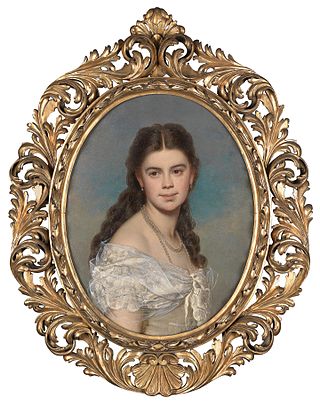
Mme du Barry
Charles I


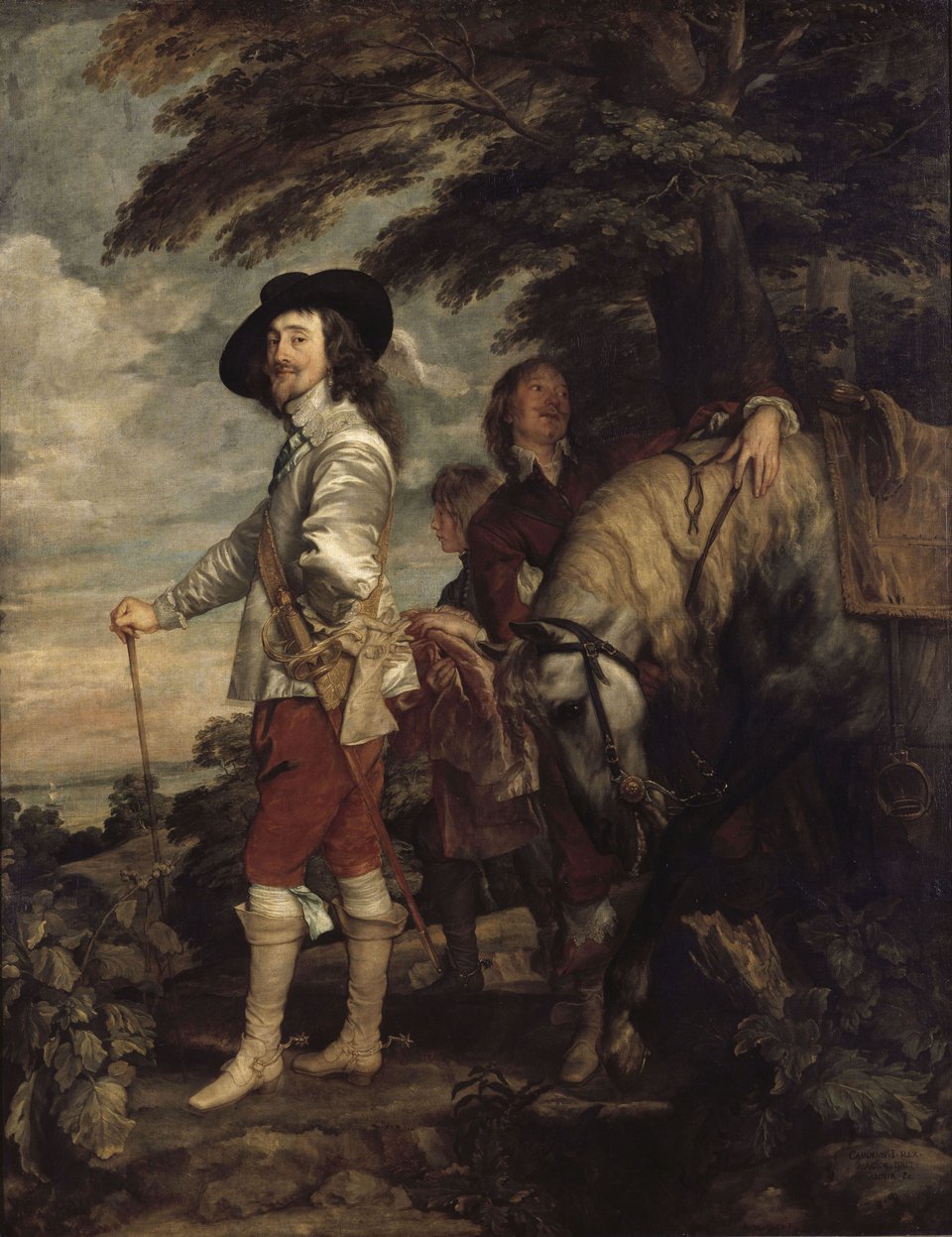
p 755 | Charles I at the Hunt by Van Dyck;  

Mme du Barry


p 769 | Causeries du lundi: Weekly essays by Sainte-Beuve; they were ruminations on authors and their works, with an emphasis on French literature. His reputation as one of the most important French literary critics of the day rested on these columns, in which he guided the literary tastes of the populace.

p 769 | Mme de Boigne: Éléonore-Adèle d’Osmond, Comtesse de Boigne, born at the Château de Versailles in 1781.

p 769 | Le Constitutionnel was a French political and literary newspaper, which published Sainte-Beuve's "Monday Chats" from Oct. 1849 to Nov. 1852 and from Sep. 1861 to Jan. 1867. They were ruminations on authors and their works, with an emphasis on French literature. His reputation as one of the most important French literary critics of the day rested on these columns, in which he guided the literary tastes of the populace.

p 769 | Paul de Noailles, 6th Duke of Noailles (1802–85), historian.

p 770 | Sophie d'Arbouville (1810-50) French poet & novelist.

p 779 | Russo-Japanese War (1904-05)

3.30.2018

The Fugitive V pp 732-52

p 736 | "...Venus was the desire of Jove...": Not sure, but sources say Jove was the father of Venus.
photo: Lionel Allorge

p 737 | Chevreuse Valley, sw of Versailles.  ==>

p 742 | Fabrice del Dongo: Romantic hero of Stendhal's La Chartreuse de Parme.

p 744 | paintings by Titian in the Louvre (at left, Woman with a Mirror, c. 1515).

p 746 | (Mme de) Pompadour provided Louis XV...: Wikipedia disputes this here.

p 751 | ... geometry in space..., psychology in time...

3.16.2018

The Fugitive V pp 712-32

p 720 | War of 1870 is the name used by the French for the Franco-Prussian War.

p 722 | Gilbert the Bad | see v. 1, p. 145: 
 "You may depend upon it, Mme. Octave," replied the Curé. "Why, it was just his Lordship himself who started the outcry about the window, by proving that it represented Gilbert the Bad, a Lord of Guermantes and a direct descendant of Geneviève de Brabant, who was a daughter of the House of Guermantes, receiving absolution from Saint Hilaire."  ... "Gilbert's brother, Charles the Stammerer, was a pious prince, but, having early in life lost his father, Pepin the Mad, who died as a result of his mental infirmity, ...Gilbert, wishing to be avenged on Charles, caused the church at Combray to be burned down, the original church, ... Nothing remains of it now but the crypt, into which Théodore has probably taken you, for Gilbert burned all the rest." 

p 725 | Da capo: an Italian musical term that means "from the beginning" (literally, "from the head").

p 731 | Gabriel Fauré: Le Secret (video), song for voice & piano in D flat major, Op. 23/3 (1880-81); Duc de Broglie's Secret du Roi; Golgotha (According to the Gospels, Golgotha was, a site immediately outside Jerusalem's walls where Jesus was crucified... Matthew's and Mark's gospels in Latin rendered Calvariæ Locus, from which the English word Calvary derives, trans. place of skulls, or Proust's Calvus Mons, or Bald Mountain); the Parc des Buttes-Chaumont in NE Paris, is the 5th largest park in the city.

p 732 | Pascal's Pensées : The Pensées ("Thoughts") is a collection of fragments on theology and philosophy written by 17th-century philosopher and mathematician Blaise Pascal.


8.07.2017

The Captive V pp 444-501

La Tour
p 454 | Casser le pot à quelqu'un: "le sodomiser" (Dictionnaire de l'argot, Larousse, 1990). This is the only mention of by Albertine of anal sex. Although the explanation that follows suggests that the expression may have been used by lesbians to denote penetrative sex in general. (Clark note) 

p 470| Maurice de La Tour (1704-88) was a French Rococo portraitist who worked primarily with pastels. Among his most famous subjects were Voltaire, Rousseau, Madame de Pompadour, and 
Louis XV.

p 485 | "... mediaeval Last Judgments..."; logarithmic tables.


p 487 | Albert I, Prince of Monaco, 1848-1922Théophile Delcassé (French foreign minister, 1898-1905; hated Germany).


p 497 | Treaty of Utrecht 1713 (King Louis XIV); Pont-aux-Choux silver designs... maybe something like this:


Bakst
p 497 | Jacques Roettiers, 18-century French gold/ silversmith; Jeanne Bécu, Comtesse du Barry (1743-93) was the mistress of King Louis XV. Josep Maria Sert (also José María Sert y Badía, Catalan painter, 1874-1945); Léon Bakst, Russian painter & set designer, 1866–1924; Alexandre Benois, Russian painter & ballet designer, 1870–1960.

p 501 | Winged Victory of Samothrace (ancient Greek sculpture in the Louvre).
Winged Victory


3.16.2017

The Captive V pp 351-69

p 355 | Georges-Louis Leclerc, Comte de Buffon (1707–88) was a French naturalist, mathematician, cosmologist, and encyclopedist.

p 355 | A tea dance, also called a thé dansant (French for "dancing tea"), is a summer or autumn afternoon or early-evening dance from 4 p.m. to 7 p.m., sometimes preceded in the English countryside by a garden party.

p 356 | A l'ombre d'un petit bois de pins qui couvre la partie supérieure de la grande ile, s'élève le Chalet, café-restaurant tenu par les glaciers Poiré-Blanche. (In the shade of a small pine forest that covers the top of the large island, stands the Chalet, café and restaurant run by Poiré Blanche glaciers [makers of ices].

p 365 | "... fall of Gaeta..." : The Siege of Gaeta was the concluding event of the war between the Kingdom of Sardinia & the Kingdom of the Two Sicilies, part of the unification of Italy. It started on November 5, 1860 and ended February 13, 1861, in Gaeta (today's Southern Lazio, Italy).


p 365 | From Manet, Wagner, and the Musical Culture of Their Time by Therese Dolan (p 33): "...The third act found little favor with the majority and the end of the opera was greeted with loud sifflements, the hissing and whistling that were the characteristic French show of disdain. Jules Janin reported that Princess Metternich broke her fan against the railing of the loge where she was seated because she pounded it in such fury at the hostile reaction of the audience." This was at the Paris debut of Wagner's Tannhäuser on March 13, 1861.
Caroline Bonaparte

p 365 | Maria Carolina Murat (1782–1839), better known as Caroline Bonaparte (a younger sister of Napoleon I), was also the Queen of Naples.

p 366 | Duras=Duchesse de Duras, 1st wife of the Duc de Duras.


p 367 | In Wagner's Die Meistersinger Von Nurnberg, the character Beckmesser is "the pedantic town clerk and master of "Die Meistersinger." ... Beckmesser can't actually create beauty himself; all he can do is find flaws, judging the new by the old..." From a music review by Edward Rothstein, New York Times, 1/24/93. 

p 369 | Bernardin de Saint-Pierre (1737–1814) was a French writer and botanist.

8.01.2016

The Captive V pp 47-64

p 47 | "...yellow dress with big black flowers...": Or maybe the black dress with the big yellow flowers...


p 47 | "... things from Callot's or Doucet's or Paquin's ...": This wonderful page from the Glamour Daze blog should make everything clear.


p 48 | Lady Warwick was Daisy Greville, Countess of Warwick, lover of King Edward VII of England. Not sure which Duchess of Marlborough Oriane is referring to; I like this one, so French!


p 52 | The Galeries Lafayette is an upmarket French department store, founded in 1912. Its flagship store is on Boulevard Haussmann in the 9th arrondissement of Paris.

p 52 | This is a little later than the period the book is in... There is some gay French history on the left side of this page.

p 53 | "Xerxes, son of Darius, ordering..." : After the battle of Salamis, the Persian fleet was destroyed by a storm in the Hellespont. Xerxes, the King of Persia, is said to have vented his feelings by having his servants beat the sea with rods.

p 54 | Social classes in 19th century Paris, with a chronology. A little earlier than the book's time setting. Nicely done.

p 54 | "... Jupien's niece had been, when scarcely more than a child, 'in trouble'..." : Consider these historical notes: 1832 - an age of consent is introduced on 28 April, fixed to 11 years for both sexes.
1863 - Age of consent is raised to 13 years.


p 57 | The House of Croy is an international family of European nobility which held a seat in the Imperial Diet from 1486, and was elevated to the rank of Princes of the Holy Roman Empire in 1594. In 1913 the family had branches in Belgium, France, Austria and Prussia. And the Princes Murat also.

p 59 | hand cramps in violinists -- a real thing!

p 60 | According to this site, before World War I, when France was firmly on the gold standard, a franc was worth about 19 cents, or 5.18 to the dollar. So, 5000 francs at that time would have been about $950. Earlier, it could have been more, so maybe about $1000.


p 63 | Violinist Jacques Thibaud (1880-1953) can be heard here.


p 64 | Syringa is lilac, pronounced like this. Well, seh-RING-gah.

10.28.2015

Sodom and Gomorrah IV pp 471-83

p 471 |  Hugo von Tschudi (1851-1911), director of the Gallery in Berlin and, unlike the Emperor, a supporter of Impressionism, was forced eventually to resign.

p 471 | Eulenberg affair (1907-9): German royal homosexual scandal. Philip, Prince of Eulenburg and (1847-1921), politician, diplomat & confidant of the German Emperor, Wilhelm II, was charged with homosexuality in 1906. Sturrock says: "In the chronology in the novel, the affair is misplaced, since Charlus is alluding to it some five years before it occurred."

p 471 | the "mediatized" families appear in the 2nd section (Durchlaucht) of the Almanack de Gotha, while the 1st section is reserved for the genealogies of Europe's royal houses. The Durchlaucht families were recognized as being equal in birth to the royal families, and intermediate in rank between them and the merely princely families of the Almanack's 3rd section. (Sturrock note)

p 472 | Commercy (link has Proust reference)

p 477 | Monsieur (from Middle French mon sieur, literally "my lord") is an honorific title that was used to refer to or address the eldest living brother of the king in the French royal court.  The pretensions of the Croy family are noted in Proust's major historical source, the Memoirs of the Duc de Saint-Simon. (Sturrock note)

p 477 | The Duchy of Aumale

p 477 | Passavant: roughly, "go forward" (from the verb passer (to pass) & avant (before, in front of). (Sturrock note)

p 478 | Prince of Savoy-Carignano; "Prince of Hanover" refers to the Elec­tor of Hanover, who became King George I of England in 1714. (Sturrock note)

p 478 | "Maecenas atavis edite regibus!": a quotation from Horace, Odes, bk. I, meaning "Maecenas, descended from royal ances­tors!"
(Sturrock note)  From Wikipedia: "His name has become a byword for a wealthy, generous and enlightened patron of the arts." Which is how Charlus makes that compliment to Mme Verdurin.
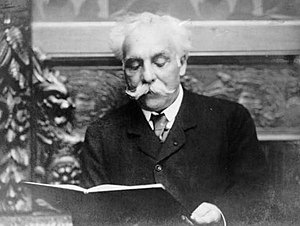
Gabriel Fauré

p 479 | ...Sonata for piano and violin: Sonata No. 1 for Violin and Piano, Opus 13, by Fauré, (listen here) first performed in 1875. 

p 480 | César Franck (1822–90) was a Belgian composer, pianist, organist & music teacher who worked in Paris.

p 481 | Giacomo Meyerbeer (born Jacob Liebmann Beer, 1791–1864) was a German opera composer of Jewish birth who has been described as perhaps the most successful stage composer of the 19th century, with his grand opera style achieved by merging German orchestra style with Italian vocal tradition. (Wiki)Robert le diable was a Romantic opera of 1831, thus rather primitive musically compared with Debussy. (Sturrock)

p 481 | Domenico Scarlatti (1685-1757), known for his harpsichord music. (Sturrock)

p 482 | Ephemerids=mayflies

p 482 | Asnières & Bois-Colombes: suburbs of Paris
 
p 483 | Rosicrucian (Gestes esthétiques): fin-de-siècle aesthetic movement in France, comparable to the "deliquescent" movement in poetry referred to earlier (not referring to 17th century German illuminati) (Sturrock)
 

p 483 | etheromaniac= person addicted to using ether as a drug.

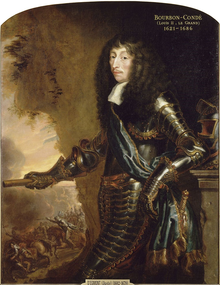
p 483 | The Great Condé: Louis II, Prince de Condé (1621-86), French general from the house of Bourbon. Leader of the so-called Fronde des Princes, or revolt against the regime of Cardinal Mazarin during Louis XIV's minority. 

9.29.2015

Sodom and Gomorrah IV pp 456-70

p 456 | Banat;  Louis d'Harcourt; Jean Anthelme Brillat-Savarin, 1755-1826): French lawyer and politician, who gained fame as an epicure and gastronome; sibylline = referring to certain women of antiquity reputed to possess powers of prophecy or divination; a female prophet or witch.

p 457 | Piquet=an early 16th-century trick-taking card game for two players. The river Dives runs through Cabourg (Balbec), this is the church by the river, Notre Dame de Dives sur mer.

p 459 | daubing: to coat or smear (a surface) with a thick or sticky substance in a carelessly rough way. 

p 459 | Paul César Helleu (1859-1927): French oil painter, pastel artist, drypoint etcher, and designer, best known for numerous portraits of beautiful society women of the Belle Époque. He also conceived the ceiling mural of night sky constellations for Grand Central Terminal in NYC. Father of Jean Helleu, grandfather of Jacques Helleu, both artistic directors for Parfums Chanel. 
Jouy

p 460 | French strawberry mousse recipe.

p 463 | See a summary of these pages here, with comments.
 
p 466 | "a piece of green lustre plugging a broken pane...": a drop-shaped piece of cut glass or crystal used as a decoration on a chandelier, vase, etc. Or, a shiny metallic surface on some pottery and porcelain.

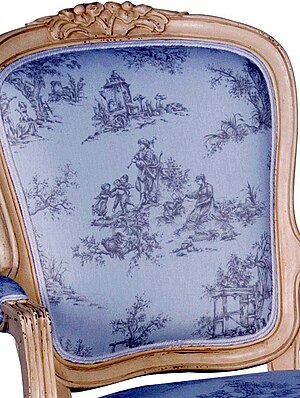
p 467 | Jouy hangings=toile de Jouy: cloth or canvas for painting on. draught-curtains are used to prevent heat loss from a room, due to drafts or weather. 

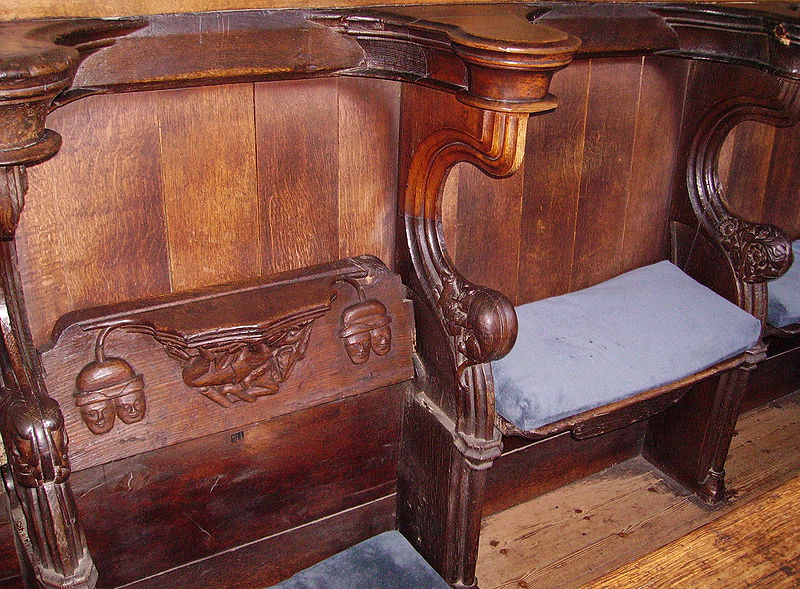
p 468 | A misericord (sometimes named mercy seat) is a small wooden shelf on the underside of a folding seat in a church, installed to provide a degree of comfort for a person who has to stand during long periods of prayer. The small shelves were available for use at times when the folding chair was required to be stored folded up, and the person expected to be in an upright position.
"Boston Stump misericord 02" by Immanuel Giel (Own work). Public Domain via Commons License
 p 468 | Agraphia: loss of the ability to write.

p 470 | "this Hohenzollern ... : with the abdication of Wilhelm II in 1918, the Hohenzollern dynasty of German emperors came to an end. The short-lived kingdom of Hanover was annexed by Prussia in 1866, and its last King was indeed dispossessed, but by Kaiser Wilhelm I, not his son. Prussia annexed Alsace-Lorraine from France following its victory in the 1870 war. (Sturrock)


9.16.2015

Sodom and Gomorrah IV pp 447-55

p 447 |  The English name "Normans" (settled in Normandy, France) comes from the French words Normans/Normanz, plural of Normant, modern French normand, which is itself borrowed from Old Low Franconian Nortmann "Northman" or directly from Old Norse Norðmaðr, Latinized as Nortmannus (recorded in Medieval Latin, 9th century) to mean "Norseman, Viking". (Wikipedia)

p 447 | The Tour d'Argent, on the Left Bank, was, and remains, one of the great restaurants of Paris; the Hotel Meurice, on the rue de Rivoli, was one of the city's best in Proust's day.
Boutroux

p 448 | Émile Boutroux (1845-1921) was an eminent 19th century French philosopher of science & religion and an historian of philosophy. He firmly opposed materialism in science. He ... defended the idea that religion & science are compatible...  His work is overshadowed... by that of his student, the more celebrated Henri Bergson. He was elected to the Academy of Moral & Political Sciences in 1898 & to the Académie française in 1912. (Wiki)

Académie française
p 448 | Académie française : The Forty are the "Immortals," or the forty members of the Académie française. Not all the names Brichot cites are actual Academicians. (Storrock)

p 448-9 | Henri Houssaye; Olivier Lefèvre d'Ormesson; Édouard René de Laboulaye: Honoré Le Peletier, comte d'Aunay; M. de Bussière; M. Albaret; M. de Cholet; M. dela Pommeraye

p 449 | Paul Porel (Paul Désire Parfouru, 1843-1917), actor &  theater director, who ran the Odéon on the Left Bank, from 1884 to 1892, hence "Odéonia." He was married to the comedienne Réjane (one of the models for Berma), who, with their son Jacques Porel were friends with Proust. 

p 449 | The Théâtre de l'Odéon is one of France's six national theatres. It is located at 2 rue Corneille in the 6th arrondissement of Paris on the left bank of the Seine, next to the Luxembourg Garden. It was originally built between 1779 and 1782, in the garden of the former Hôtel de Condé, to a Neoclassical design by Charles De Wailly and Marie-Joseph Peyre. The Odéon was originally intended to house the Comédie Française, which, however, preferred to stay at the Théâtre-Français in the Palais Royal. The new theatre was inaugurated by Marie-Antoinette on April 9, 1782.

p 450 | Even though Moncrieff uses "-ast" here, the French has "-arder", which Sturrock suggests could possibly stand for pétarder, meaning "to blow one's top" -- and possibly several other slangy meanings. I think Moncrieff used his translator's licence to indicate that the two men were gossiping about Charlus being gay (i.e., "pederast"). Remember Marcel has already indicated that the people in one's social circle wouldn't mention or notice it, but outsiders would do both.

p 452 | La Chercheuse d'esprit, a comic opera with words by Charles-Simon Favart (1710-92) and music by Jean-Claude Trial (1732-71), first presented in 1741.

p 453 | The Sarmatians were a large confederation of Iranian people during classical antiquity, flourishing from about the 5th century BC to the 4th century AD. They spoke Scythian, an Indo-European language from the Eastern Iranian family.

p 454 | ... the Rohans...: The House of Rohan is a French noble family of viscounts, later dukes and princes, coming from the locality of Rohan in Brittany. 

architrave
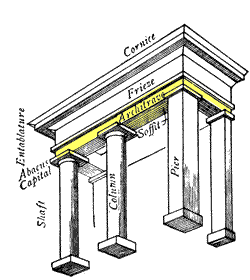
p 454 | architrave: the lintel or beam that rests on the capitals of the columns. It is an architectural element in Classical architecture.
Odéon
the lintel or beam that rests on the capitals of the columns. It is an architectural element in Classical architecture.
p 455 | galantine: A galantine is a Polish dish of de-boned stuffed meat, most commonly poultry or fish, that is poached and served cold, coated with aspic.

p 455 | Mme Jeanne Samary: 19th century actress and model (Renoir's lover for a while).


p 455 | Le Capitaine Fracasse by Théophile Gautier: This book was promised to the public in 1836 but finally published in 1863. It is centered on a soldier named Fracasse whose adventures portray bouts of chivalry, courage and a sense of adventure. Gautier places the story in his favourite historical era, that of Louis XIII. It is best described as a typical cloak-and-dagger fairy tale where everyone lives happily ever after.


9.05.2015

Sodom and Gomorrah IV pp 372-97

p 372 | William= German Emperor Wilhelm II. 

p 373 | the Abbaye-aux-Bois: where the celebrated hostess Mme de Récamierher had her salon in Paris, at which, during the 1820s, the great Romantic writers, Chateaubriand among them, read their works in public. 

p 373 | Émilie du Châtelet (1706-49), French mathematician, physicist, and author during the Age of Enlightenment, who had a long liaison with Voltaire. 

p 373 | ... Roman Empress...: possibly Agrippina, wife of Claudius I and mother of Nero, famous for her domineering ways.  (Sturrock) 

p 373 |... like Christ or the Kaiser...: a reference to Christ's injunction in Matthew 10:37; and to Kaiser Wilhelm II's declarations of 1891 that "The will of the King is the supreme law" and that soldiers should obey "without a murmur" if ordered to fire on their own families. (Sturrock) 

p 374 | "You alone did seem ...": "Toi seule me parus ce qu'on cherche toujours." (from Vigny) 

p 378 | Pierre Potain (1825-1901), a prominent Paris medical man, with several literary patients 
(see the Goncourts' Journal); Jean-Martin Charcot (1825-93), greatest of 19th-century neurologists in France, who influenced young Freud when he was a medical student in Paris.

p 380 |the comedies of Pierre de Marivaux (1688-1763) contain numerous aristocrats, but no baronnes. (Sturrock)

p 380 | Eugene Viollet-le-Duc (1814-79) was a champion of Gothic architecture, responsible for the restoration of many medieval buildings. 

p 381 | "Charles-Maurice, Abbé of Perigord"=Talleyrand, both an unbeliever and a Catholic bishop.

p 384 | Vincent d'Indy (1851-1931), composer & teacher, was outspokenly anti-Dreyfus, and also anti-Semitic. The position of Claude Debussy (1862-1918) was more nuanced; ironically, the fiercely partisan disagreements as to the merits or otherwise of his opera, Pelléas et Mélisande , caused it later to be likened to the Dreyfus Affair.

Molière
p 386 | squireen: A person who is half squire, half farmer.  
p 387 | Henri Meilhac (1831-97) wrote plays and comic operas, the best-known of which is La belle Hélène. Brichot is referring to Pascal's famous pensée: "If Cleopatra's nose had been shorter, the whole face of the earth would have been changed." (Sturrock) 
p 393 | Jean-Baptiste Poquelin was the real name of Molière, whose absurd character Argan, in Le malade imaginaire, is the model for Proust's pastiche of medical jargon. Mr. Purgon, a character from the same play.    (Sturrock) 

p 387 | "Uncle, I mean Sarcey": Francisque Sarcey (1827-99) was the leading drama critic of the day, nicknamed "Uncle" for his good sense and middlebrow tastes.   (Sturrock)
 

p 397 | Phineas Taylor Barnum (1810-91), the archetypal American showman and publicist.