Pages

Showing posts with label Nobility. Show all posts

4.06.2018

The Fugitive V pp 752-82

p 754 | All Saints' Day: a Christian festival in honor of all the saints, held (in the Western Church) on November 1.

Mme du Barry
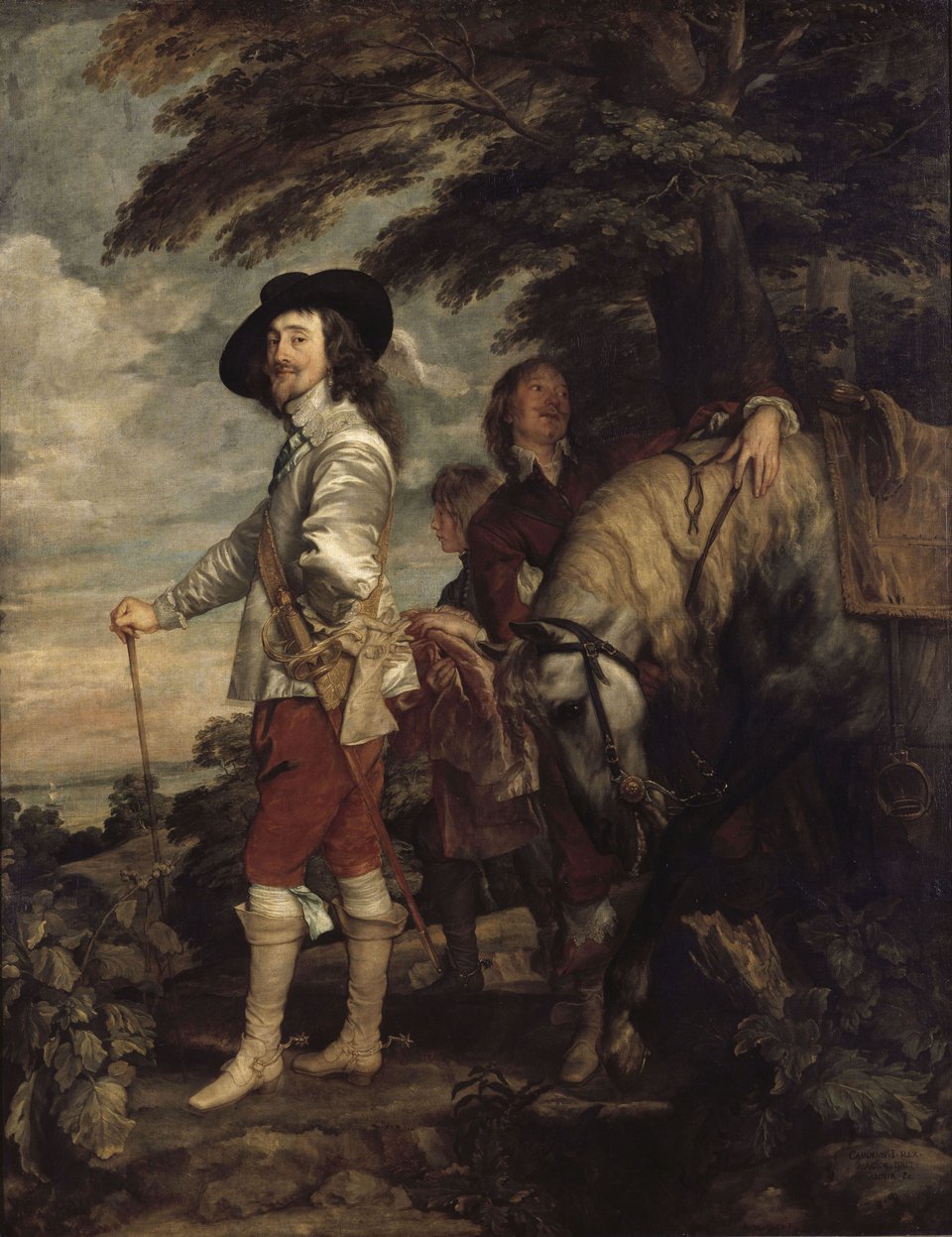
Charles I


p 755 | Charles I at the Hunt by Van Dyck;  

Mme du Barry


p 769 | Causeries du lundi: Weekly essays by Sainte-Beuve; they were ruminations on authors and their works, with an emphasis on French literature. His reputation as one of the most important French literary critics of the day rested on these columns, in which he guided the literary tastes of the populace.

p 769 | Mme de Boigne: Éléonore-Adèle d’Osmond, Comtesse de Boigne, born at the Château de Versailles in 1781.

p 769 | Le Constitutionnel was a French political and literary newspaper, which published Sainte-Beuve's "Monday Chats" from Oct. 1849 to Nov. 1852 and from Sep. 1861 to Jan. 1867. They were ruminations on authors and their works, with an emphasis on French literature. His reputation as one of the most important French literary critics of the day rested on these columns, in which he guided the literary tastes of the populace.

p 769 | Paul de Noailles, 6th Duke of Noailles (1802–85), historian.

p 770 | Sophie d'Arbouville (1810-50) French poet & novelist.

p 779 | Russo-Japanese War (1904-05)

4.10.2016

Sodom and Gomorrah IV pp 662-691

Berthe de Clinchamp,
p 666 | Aldonce de Guermantes is an invention. Because Louis VI (known as le Gros, 1081-1137), had an illegitimate younger half-brother, called Philippe de Mantes, he had himself crowned quickly in 1108 to ensure his own succession.

p 666 | The La Trémoilles became heirs to the Kings of Naples in 1605; their descent from the Comtes de Poitiers is uncertain. Uzès did not become a duchy until 1572.

p 667 | The first Duc de Luynes was created in 1619. The Choiseuls, the Harcourts, the La Rochefoucaulds... are families who traced their origins back to the 10th century. ...the Noailles ... the Montesquious, the Castellanes can be traced back to the 11th century.

p 667 | Vatefairefiche = va-te-faire-fiche means "Scram!" (Gotoblazes). Turning Cambremer into Cambremerde is a vulgarization of the name.

p 668 | Scènes de la vie de province is one of the major sections of Balzac's Comédie Humaine. La Muse du département is part of the Scènes de la vie de province; its heroine, Mme de la Baudraye, writes literary essays and has an adulterous love affair. Mme de Bargeton is a character in Illusions perdues, a provincial wife who becomes the lover of the young hero, Lucien de Rubempré. Mme de Mortsauf was the heroine of Le Lys dans la vallée, who overcomes her passion for the young Félix de Vandenesse and dies a saintly death.

p 672 | Berthe de Clinchamp, companion of the Duchesse d'Aumale, came eventually to run the Duc's household, and in 1899 published a memoir of him: Le Duc d'Aumale, prince, soldat.p 673 | In media stat virtus = virtue lies in the middle.

p 674 | ... M. Moreau, Morille, Morue...: Moreau can mean a horse's nosebag; a morille is a morel (mushroom); morue is a codfish.

p 681 | Subaltern = an officer in the British army below the rank of captain, especially a second lieutenant. Saint-Cyr = military academy where French Army officers are trained.

p 688 | Pont-l'Éveque: Éveque is French for "bishop." Childhood of Christ is an oratorio written by Berlioz between 1850 and 1854; L'Enchantement du Vendredi Saint, or The Good Friday Music forms part of Act III of Wagner's opera Parsifal, but is sometimes performed separately, especially at Easter.


Decreuse - Louis IX of France
King Louis IX

p 689 | Rue de Blancs-Manteaux: literally, White Mantles or White Friars, a Carmelite order.

p 690 | Saint Louis = Louis IX, King of France 1226-70, canonized in 1287.


p 690 | Felix de Rochegude's 20-volume work Promenades dans toutes les rues de Paris (1910). The street Charlus can't remember was the rue des Rosiers & "du Rozier'' later will become the name Bloch takes to hide his Jewishness. Though not a Jew, Rembrandt lived in the Amsterdam's Jewish quarter & painted Jewish subjects. Legend about a 13th century Jew convicted of burning a consecrated Host, which was itself miraculously preserved.

p 690 | According to Rochegude, this Louis I d'Orléans (1372-1407) was murdered by Jean sans Peur on coming out from supper with Isabeau de Bavière, his sister-in-law & mistress. The Duc de Chartres (1840-1910) was the grandson of Louis-Philippe, Duc d'Orléans (also known as Philippe-Égalité, 1747-1793), and not obviously related to Charlus.


N.B. All entries based primarily based on Sturrock's notes.

4.07.2016

Sodom and Gomorrah IV pp 639-662

p 638 | Tantus ab uno splendor = Such brilliance coming from one person. 

p 639 | Mort m'est vie = Death, to me, is life.


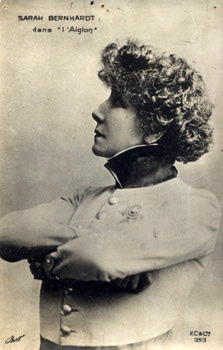
p 639 | In 1900, Sarah Bernhardt created the title role in Edmond Rostand's successful L'Aiglon. Jean-Sully Mounet (1841-1916), called Mounet-Sully, played Oedipus in the Roman arena at Orange (not Nîmes).


p 640 | ...contre-de-quartes reminiscent of Molière: referring to the fencing lesson in Le Bourgeois gentilhomme, a contre-de-quarte is a circular parrying movement of the sword.
 
p 643 | Mazagran = coffee laced with rum; gloria = a mixture of sweet coffee & rum or eau-de-vie.  Eugène Marin Labiche, French dramatist, 1815-88.  Os homini sublime dedit coelumque tueri:  "He has given man a face turned toward the sky," a line from Ovid's Metamorphoses.


p 644-45 | ...Archangel Raphael ... Tobias: this story is in the book of Tobit, in the Apocrypha.

p 657 | Verjuice = the juice from unripe grapes.


p 659 | Constant Coquelin, known as Coquelin aîné, a well-known actor (1841-1909).

p 660 | The Société des Bibliophiles Français was founded in 1820 of mainly aristocrats; the Union Club was founded in 1828 and was the most exclusive Paris club during the Second Empire.

p 661 | The Montgomery & Pembroke families were associated, as were the Chandos family & the Buckinghams. A Capel became Count of Essex in 1661, and Proust knew Berthe Capel in Paris. The Duc de Berry (1844-1910) was a member of the Orléans family.   

p 661 | Émilienne d'Alençon (Émilienne Andrée) was a celebrated courtesan around 1900, who dabbled in music & poetry & appeared with performing rabbits at the Folies-Bergère.

>p 661 | Ne sçais l'heure = I don't know the hour (of my death). It's pronounced like the name Saylor.

p 662 | Jean-Alexis Périer (1869-1954) created the role of Pelléas in Debussy's opera in 1902.  The Théâtre du Gymnase specialized in comedy; La Châtelaine was a comedy by Alfred Capus (1858-1922), a dramatist & journalist who was elected to the Académie Française in 1914.  Simone Frévalles, actress in La Châtelaine , as well as the company at the Théâtre de la Porte-Saint-Martin.  Marie Magnier (1848-1913) made her debut in 1867 and played in many Paris theaters; Louis Baron (1870-1939), known as Baron fils to distinguish him from his actor father, was a well-known comic actor at the turn of the century.

p 663 | Yvette Guilbert (1867-1944) began her celebrated career as a chanteuse around 1885. Ernest Cornaglia (1834-1912), an actor who joined the company at the Théâtre de l'Odéon in 1880; Émile Dehelly (1871-1969) debuted at the Comédie-Française in 1890.

N.B. All entries based primarily based on Sturrock's notes.

10.28.2015

Sodom and Gomorrah IV pp 471-83

p 471 |  Hugo von Tschudi (1851-1911), director of the Gallery in Berlin and, unlike the Emperor, a supporter of Impressionism, was forced eventually to resign.

p 471 | Eulenberg affair (1907-9): German royal homosexual scandal. Philip, Prince of Eulenburg and (1847-1921), politician, diplomat & confidant of the German Emperor, Wilhelm II, was charged with homosexuality in 1906. Sturrock says: "In the chronology in the novel, the affair is misplaced, since Charlus is alluding to it some five years before it occurred."

p 471 | the "mediatized" families appear in the 2nd section (Durchlaucht) of the Almanack de Gotha, while the 1st section is reserved for the genealogies of Europe's royal houses. The Durchlaucht families were recognized as being equal in birth to the royal families, and intermediate in rank between them and the merely princely families of the Almanack's 3rd section. (Sturrock note)

p 472 | Commercy (link has Proust reference)

p 477 | Monsieur (from Middle French mon sieur, literally "my lord") is an honorific title that was used to refer to or address the eldest living brother of the king in the French royal court.  The pretensions of the Croy family are noted in Proust's major historical source, the Memoirs of the Duc de Saint-Simon. (Sturrock note)

p 477 | The Duchy of Aumale

p 477 | Passavant: roughly, "go forward" (from the verb passer (to pass) & avant (before, in front of). (Sturrock note)

p 478 | Prince of Savoy-Carignano; "Prince of Hanover" refers to the Elec­tor of Hanover, who became King George I of England in 1714. (Sturrock note)

p 478 | "Maecenas atavis edite regibus!": a quotation from Horace, Odes, bk. I, meaning "Maecenas, descended from royal ances­tors!"
(Sturrock note)  From Wikipedia: "His name has become a byword for a wealthy, generous and enlightened patron of the arts." Which is how Charlus makes that compliment to Mme Verdurin.
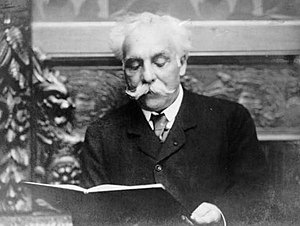
Gabriel Fauré

p 479 | ...Sonata for piano and violin: Sonata No. 1 for Violin and Piano, Opus 13, by Fauré, (listen here) first performed in 1875. 

p 480 | César Franck (1822–90) was a Belgian composer, pianist, organist & music teacher who worked in Paris.

p 481 | Giacomo Meyerbeer (born Jacob Liebmann Beer, 1791–1864) was a German opera composer of Jewish birth who has been described as perhaps the most successful stage composer of the 19th century, with his grand opera style achieved by merging German orchestra style with Italian vocal tradition. (Wiki).  Robert le diable was a Romantic opera of 1831, thus rather primitive musically compared with Debussy. (Sturrock)

p 481 | Domenico Scarlatti (1685-1757), known for his harpsichord music. (Sturrock)

p 482 | Ephemerids=mayflies

p 482 | Asnières & Bois-Colombes: suburbs of Paris
 
p 483 | Rosicrucian (Gestes esthétiques): fin-de-siècle aesthetic movement in France, comparable to the "deliquescent" movement in poetry referred to earlier (not referring to 17th century German illuminati) (Sturrock)
 

p 483 | etheromaniac= person addicted to using ether as a drug.

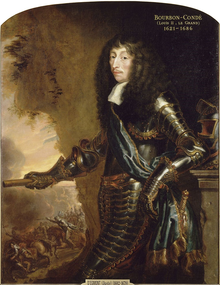
p 483 | The Great Condé: Louis II, Prince de Condé (1621-86), French general from the house of Bourbon. Leader of the so-called Fronde des Princes, or revolt against the regime of Cardinal Mazarin during Louis XIV's minority. 

6.11.2015

Sodom and Gomorrah IV p 203-245

p 205 | Caen

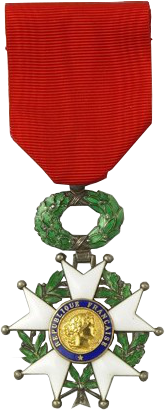
p 205 | French Legion of Honour
 
p 205 | L'Écho de Paris was a daily newspaper in Paris, 1884 to 1944.

Caillaux
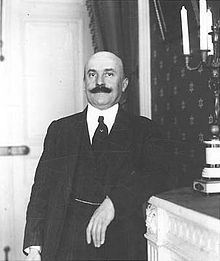
p 205 | Joseph Caillaux (1863-1944), a Radical politician who served as prime minister from 1911 to 1912.

p 205 | "under the thimble ... thumb": the manager says "sous la coupole" instead of "sous la coupe," which improves the joke, since "sous la coupole" refers to the meeting place of the Académie Française (being re­ceived sous la coupole means being elected to the Academy). (Sturrock)


p 210 | M. Paillard was a well-known Paris restaurant, patronized by some of Proust's friends.

From  A Companion to Evelyn Waugh’s Brideshead Revisited: "Paillard’s was one of leading restaurants of Paris... created in 1880 when M. Paillard took over an establishment situated at the corner of the Rue de la Chaussée-d’Antin and the Boulevard des Capucines from the Bignon brothers. According to Larousse Gastronomique, ‘Favourite dishes were chicken Archduke, Georgette potatoes, calves’ sweetbreads with asparagus tips, fillets of sole Chauchat and, above all, stuffed duck, rivalling the duck au sang of the Tour d’Argent.’  The culinary term paillard is of course named after the famous chef, who trained under the great Escoffier himself. It is a thin slice of veal (or now, any meat) pounded even thinner until it is translucent and then grilled or fried for a few seconds only."
p 216 | Lethe: the stream of oblivion & forgetfulness, was one of the rivers of the underworld and its goddess (Greek mythology).
Jammes

p 218 | Francis Jammes (1868-1938) wrote simple poetry, often on the theme of innocence re­covered. The stag in this dream sequence appears to derive from a story by Flaubert, "The Legend of Saint Julien the Hospitaler," in which a stag predicts to Julien that he will kill his father & mother (this reference may be relate to Proust’s guilt about the death of his mother). The fork comes from an earlier draft of the novel, where the sound of a fork striking a plate triggers the Narrator’s involuntary memories (like the madeleine). In the final book (Time Regained), the fork has become a spoon.(Sturrock)  After reading Swann's Way, Jammes wrote Proust a letter comparing him to Shakespeare and Balzac.

p 219 | Aias: Greek for Ajax in the Iliad, who, in his madness killed sheep & shepherds after mistaking them for fellow Greeks. (Sturrock)


p 223 | barouche: carriage

p 223 |Jonathan, i.e., John the Baptist. (Sturrock)
 
p 228 | Duc d’Orléans…: only two of the four separate houses of Orléans ever succeeded to the throne, with the second occasion in 1830, with King Louis-Philippe; the title of Prince de Tarente belonged indeed to the house of La Trémoille.

p 229 |Mme Marie de Sévigné (1626-96), considered to be one France’s greatest letter-writers; Proust admired the quick, spirited impressionism of her style. Mme de Beausergent is a character, not a person.(Sturrock)

p 231-2 | Bertrand de Salignac-Fénélon (1878-1914) was killed in the opening months of WWI. He was descended from a brother of François de Salignac de La Mothe-Fénélon (1651-1715), writer, theologian, Archbishop; also known as the “Swan” of Cambrai, whose Aventures de Télémaque were interpreted as a veiled attack on Louis XIV.< (Sturrock).  He was Proust's very good friend and partial model for Saint-Loup.


p 232 | René Duguay-Trouin, Sieur du Guay (1673-1736), a sailor whose statue stands in his native Saint-Malo. (Sturrock)

p 232 | whitlow: an infection of the tip of the finger.

p 234 | The Abbess of Fontevrault was Marie-Madeleine Gabrielle de Rochechouart (1645-1704), who was the older sister of Françoise-Athénaïs de Rochechouart (1640-1707), the Marquise de Montespan, who was the mistress of King Louis XIV

p 235 | Panathenaea: an Athenian festival to honor the goddess Athena, depicted on a frieze on the Parthenon, fragments of which are in the British Museum & the Louvre. (Sturrock)

p 240-1 | syncope ("sincup"): a short loss of consciousness and muscle strength, fainting, passing out.

p 243 | "angel lutanists, Italian cathedral, porphyry, jasper... " maybe Cappella Di San Brizio (Duomo) in Orvieto.

3.19.2015

Sodom and Gomorrah IV pp 177-95

p 189 | Jojotte...: nickname of portrait painter Georges Clarin (1843-1919), who signed the first petition in favor of Dreyfus, after Zola’s “J’accuse” was published. He frequently painted Sarah Bernhardt. (Sturrock)


Atlantic auger 0008 by Edward T. Babinski
 p 190 | "...crenellated turret of its shell...

p 191 | Cours-la-Reine: avenue that runs along the Seine between the Place de la Concorde and the Grand-Palais. (Sturrock)

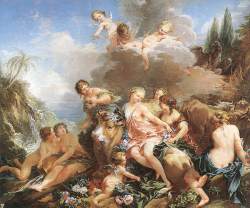
p 191 | "Beauvais armchair illustrating the Rape of Europa...": this chair and this 1747 painting by François Boucher: 


p 191-2|"... pictures of society...": Does this refer to Proust's first book, Pleasures and Regrets ? (full French text of Les Plaisirs et les Jours is here)

p 193 | The Consulate ran from 1799 to 1804, with Napoleon the de facto ruler of France as First Consul…; the Direc­tory had lasted from 1795 to the coup d’état of November 1799, when Napoleon seized power. The two regimes fostered distinct cultural styles. (Sturrock)


Firebird by Bakst
p 193 |Sergei Diaghilev’s Ballets Russes created a sensation in Paris from their first appearance there in 1909. Léon Bakst (1866-1924) was the foremost designer of their sets and costumes; Vaslav Nijinsky (1890-1950) was the most celebrated Russian male dancer; Alexandre Benois (1870-1960) was a painter who also designed stage sets; Igor Stravinsky (1882-1971) wrote some of his best-known music for Diaghilev, notably The Firebird and The Rite of Spring; Princess Yourbeletieff is an invented character. (Sturrock)


 p 193 | Aigrette (from the French for egret) refers to the tufted crest or head-plumes of the egret, used for adorning a headdress; also, any similar ornament made of gems.

p 194 | Avatar: A temporary manifestation or aspect of a continuing entity, i.e., occultism in its present avatar.

p 195 |"... gimlet eyes of nationalist ladies..." : sharp or piercing, as this tool.

p 195 | While searching for the Princesse d'Epinoy, I found this wonderful essay on nobility and titles in France.

7.19.2011

Within a Budding Grove (vol II pp 449...) French noble titles - Notes for July 2011

From a rather interesting article on French nobility and/or titles over at Heraldica.org:
"The origin of modern titles like duke, marquis, count lie in public offices held under Merovingian kings (6th-8th c.).
  • A duke (Latin dux, literally "leader") was the governor of a province, usually a military leader.
  • A count (Latin comes, literally "companion") was an appointee of the king governing a city and its immediate surroundings, or else a high-ranking official in the king's immediate entourage (the latter called "palace counts" or "counts Palatine").
  • A marquis was a count who was also the governor of a "march," a region at the boundaries of the kingdom that needed particular protection against foreign incursions (margrave in German).
  • A viscount was the lieutenant of a count, either when the count was too busy to stay at home, or when the county was held by the king himself.
  • A baron (a later title) was originally a direct vassal of the king, or of a major feudal lord like a duke or a count.
  • A castellan (châtelain) was the commander in charge of a castle.  A few castellanies survived with the title of "sire."
"An edict of 1575, rarely enforced, established a minimum size and income for the land to which the created title was attached, thus establishing a hierarchy which was purely notional:
  • duc (duke)
  • marquis (marquis)
  • comte (earl)
  • vicomte (viscount)
  • baron (baron)"