Pages

Showing posts with label Links. Show all posts

7.01.2020

Articles about Proust

From LitHub:
 How the French Reread Proust. There Are Three Types of People, and All of Them Reread Proust By Laure Murat 7/16

When Marcel Proust Was an Anxious Debut Novelist. On the Launch of In Search of Lost Time By William Carter 7/16

Six Writers on the Genius of Marcel Proust: Siri Hustvedt, Edmund White, Andre Aciman, Francine Prose, Aleksandar Hemon, and Daniel Mendelsohn  7/16

Literary Frenemies: Jean Cocteau and Marcel Proust By Claude Arnaud 10/16

On the Boyhood Classmates Who Drove Proust to Write.   First He Was Transfixed, Then He Was... Disappointed.   By Caroline Weber  5/18

On the horribly awkward night James Joyce met Marcel Proust. By Jonny Diamond 5/20

Really, Here’s Why You Should Read Proust. His Biographer Makes the Case.  By William C. Carter 7/16  

Two Never-Before-Published Letters from Marcel Proust to His Neighbor.   Lydia Davis Translates a Couple of Requests for Quiet 8/17  

The Polish Army Officer Who Conjured Proust in a Soviet Prison Camp: On Józef Czapski's Wartime Lectures  By Eric Karpeles  11/18

Interesting Random Links to the Man & the Novel

  • Someone asked The Paris Review which translation of Proust to read and their answer is "Start with Davis, then switch to Montcrieff/Enright.

  • From Paul La Farge’s Favorite Reads from 2011: "...And finally, the award for Most Shocking Rhythm Change near the End of a Long Novel goes to Marcel Proust for Le Côté de Guermantes, in which the narrator, having done more or less nothing for many hundreds of pages, finally, in a fit of rage, stomps on the Baron de Charlus’s hat." (12/15/11)

  • Lorin Stein, new editor of the Paris Review, on Jewish writers...  "...The other writers, the ones who are our age—for them it’s a fact of life that doesn’t need to be celebrated particularly. It almost sounds odd to call Lipsyte a Jewish writer. We call Proust a Jewish writer, I think, because he wrote so much about being Jewish. (Plus—if you can claim Proust, you claim Proust.) ..." (6/2/11)

  •   "...Through his eyes we see what actuates the dandy and the lover and the grandee and the hypocrite and the poseur, with a transparency unexampled except in Shakespeare or George Eliot. And this ability, so piercing and at times even alarming, is not mere knowingness. It is not, in other words, the product of cynicism. To be so perceptive and yet so innocent—that, in a phrase, is the achievement of Proust. It is also why one does well to postpone a complete reading until one is in the middle of life, and has shared some of the disillusionments and fears, as well as the delights, that come with this mediocre actuarial accomplishment."      From The Acutest Ear in Paris : Christopher Hitchens examines the Davis translation in The Atlantic Monthly, Jan 2004 

  • One-minute video of Alain de Botton telling why he wrote his self-help book, How Reading Proust Can Change Your Life. See many other videos by searching on "Marcel Proust."

  • Stephane Heuet's series of graphic-novel versions of RTP. Amazing books. NPR interviewed (4 minutes) Heuet when the combined & re-translated English edition came out in 2016 to mixed reivews.

=======================

Paul Murray, author of Skippy Dies, is reading Proust.

Angel: What are you reading? Murray: I’m reading Within a Budding Grove. Proust.

Angel: Is In Search of Lost Time a book you’ve meant to read for a long time and finally got around to reading?  Murray: Well, actually I was pretty daunted by it, so I’d set it by for my retirement. But the book I’m working on now has a French narrator so I thought I should bone up on French culture. I’m reading it in English, but I thought that this was a key text and it is the key text. I’m realizing while I’m reading it that it is so influential. 

Angel: Which translation are you reading? Murray: I’m reading the Scott Moncrieff translation.  

Angel: How many hours a day do you devote to that? Murray: Nabokov wrote an essay about the first volume in which he says, “In Search of Lost Time makes up 4,000 pages which are about a month’s reading.” That’s Nabokov. It took me a month to read the first volume. The sentences are so convoluted you have to read almost every single one twice. The first time round you’re just looking for the verb, then you go back and work out what he’s talking about. So it’s slow going. And I’m reading other stuff, too. {....}

3.01.2015

Chasing Lost Time: The Life of C. K. Scott Moncrieff: Soldier, Spy, and Translator


12.29.2013

And only 65 G's

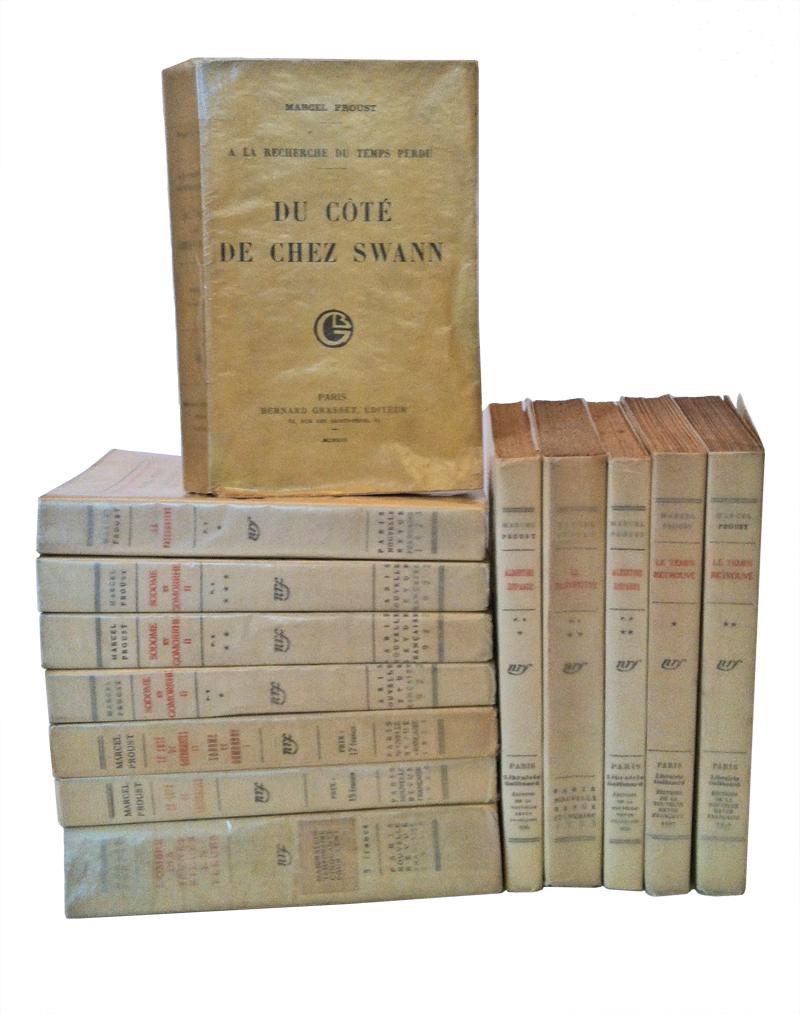
The real first edition
And it's in Brooklyn!

2.15.2012

Proust for Nook -- all books in one file! (Modern Library ed.)

In Search of Lost Time, complete & unabridged, 6 books: Volumes I-VI: Swann's Way, Within a Budding Grove, The Guermantes Way, Sodom and Gomorrah, The Captive & The Fugitive, Time Regained.

Also for kindle.

7.15.2011

Proust Online Course

Professor Carter's online Proust course appears to be ongoing.

2.16.2011

Radio Proust has been updated

Have a look at the Radio Proust website at Bard.  Many updates, videos, new photographs, and links to information and courses.

1.20.2011

Random Proust Sightings

February 15, 2011 Posted by Vicky Raab
When I started “The Evolution of Bruno Littlemore,” I began to have worrisome Proustian flashbacks of being a chimp in a weird but normal family of very cute chimps in very cute outfits who lived in my house and ate coveted breakfast cereals with me—Wheat Chex, Corn Chex, and Rice Chex—who are maybe on “The Ed Sullivan Show” around the time of the Beatles?  Read more New Yorker Book Bench blog
Published there in 2005 and discovered in a Paris book shop by FSG editor Lorin Stein (who commissioned an English translation, appearing in paperback this month), 03 is a single paragraph that runs for 85 pages, a young man's simultaneously punkish and Proustian meditations on his attraction toward a mentally disabled girl at a bus stop. The Daily Beast

6.10.2010

For sale

A site called Art.com offers a photograph of Proust, framed or unframed, then offers views of how it would look in various rooms of your home. I'm thinking about where he'd look best...

3.27.2010

Translators, Biographers, Scholars


Scottish translator, born in Stirlingshire, educated at the University of Edinburgh. Best known for his inspired translations from the French, beginning with The Song of Roland (1919, Chanson de Roland), his letters, collected in C. K. Scott-Moncrieff: Memories and Letters (1931, edited by J. M. Scott-Moncrieff and L. W. Lunn), reveal his own accomplishment as a writer.

After working as a private secretary to Lord Northcliffe, and writing for The Times, he began his famous translations of Proust's Remembrance of Things Past (A la recherche du temps perdu): Swann's Way (1922), Within a Budding Grove (1924), The Guermantes Way (1925), Cities of the Plain (1927), The Captive (1929), and The Sweet Cheat Gone (1930). He died before completing the work (later revised by Terence Kilmartin), but Scott-Moncrieff's great translation is generally recognized as itself a masterpiece of the art, some reviewers declaring it even superior to the original. He also translated Stendhal, including The Red and the Black (Le rouge et le noir, 1926), Pirandello, and Beowulf, and edited Marcel Proust: An English Tribute (1923).  Portrait by Edward Stanley Mercer in the National Galleries of Scotland.    More at Wikipedia.
 ~~~~
Stephen Hudson was a pseudonym of the British novelist Sydney Schiff (1868–1944). He was the host at a party in Paris on May 18, 1922, when Marcel Proust met James Joyce. He and his wife Violet were friends of Proust, and donated their letters from him to the British Museum 
 ~~~~
Frederick BlossomHudson's version [of The Past Recaptured / Time Regained] did not satisfy U. S. publishers A. & C. Boni, who chose Frederick A. Blossom, Ph. D., ex-professor at Johns Hopkins, to make the U. S. translation — careful, sober, with occasional Ph. D. irruptions into footnotes. (Time magazine, 8/29/32)
 ~~~~
Terence Kilmartin was the literary editor of The Observer from 1951-1985.
 ~~~~
Once written, twice deflowered: In search of lost time (Enright review)
D. J. Enright, poet & scholar

                                                                                                      ~~~~


Interview with Lydia Davis
Lydia Davis cooks a duck


12.08.2009

Hard to Read Proust?

Nah! Not after you read this lovely essay by Marcelle Clements on how to do it. Many thanks to Virginia for unearthing this inspiring gem at Oprah's. It begins:
"Some readers are lucky; they fall in love with Proust on page one and enter a sort of rapture that transports them through all six volumes of In Search of Lost Time. Others struggle, resist, quit in a huff. My guess is that many readers are alternately smitten and outraged by Proust's prose style, especially in the opening pages, when we are in the dark—or rather, in a room where the drapes are drawn—and the only thing we can figure out with any certitude is that the narrator is unable to get to sleep and that this reminds him of many other sleepless nights...."
The essay continues here, on Oprah's website.  Enjoy. And thank you again, VA!
~~~~~~~~~~~~~~~~~~~~~~~~~~~~~~~~~~~~~~
But wait! There's more!  Here's the late, great Russell Baker making a case that reading Proust is like climbing Mount Everest....(no way)
~~~~~~~~~~~~~~~~~~~~~~~~~~~~~~~~~~~~~~~~~~~~~~~~~~~~~~~~~~
Here's someone else (LanguageHat) who finished reading it.