Pages

Showing posts with label Food. Show all posts

2.28.2018

The Fugitive V pp 654-95

ruins, 1871
p 657 | The Château de Saint-Cloud was one of Marie-Antoinette's châteaux, where Napoleon & Napoleon III declared themselves Emperor in their turn (in 1804 & 1852). It was built on a site over-looking the Seine about 5 km (3.1 mi) west of Paris.  The château was expanded by Phillipe of France, Duke of Orléans in the 17th century, and again by Marie-Antoinette in the 1780s. In 1870, during the Franco-Prussian War, the château caught fire; most of the contents had been removed by Empress Eugénie. The standing roofless walls were finally razed in 1891. Now, a large park is on the site of the former palace, the Parc de Saint-Cloud, owned by the state. 

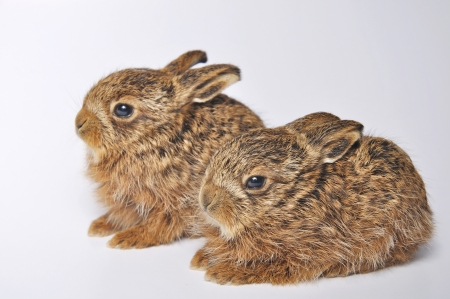
p 671 | Ortolans, leverets (a hare less than one year old),  rock-partridges...

p 675 | Byzantine Norman architecture

p 684 | novel in which a woman chooses not to speak (still searching)

p 695 | the baths at Balbec (Cabourg): Thalassotherapy: using sea-water as a form of therapy. Rules for sea-bathing at nearby Houlgate.

p 695 | A lorgnette is a pair of spectacles with a handle to hold them in place, rather than fitting over the ears or nose. The word "lorgnette" is derived from the French lorgner, to take a sidelong look at, and Middle French, from lorgne, squinting. They were invented by Englishman George Adams.


10.30.2016

The Captive V pp 156-168


p 159 | Renaissance Pietà: There are others, but Michaelangelo's is the main one.

p 161 | Prunier Restaurant in Paris specialized in seafood.

p 161 | Here's mackerel! (Il arrive le maquereau) = a pun because maquereau is French slang for a pimp, hence his thought wanders to the chauffeur.

p 161 | Cos lettuce=Romaine

p 162 | Praeceptis salutaribus moniti et divina institutione formati audemus dicere : "Instructed by Thy saving precepts, and following Thy divine institution, we are bold to say..." This is the opening to the Lord's Prayer in the Mass liturgy.

p 162 | Suave mari magno="How pleasant when on a great sea..." (Lucretius). These opening lines of Book II of Lucretius' poem De rerum naturae observe how pleasant it is, when we are on dry land, to watch another man battling to stay afloat in a stormy sea. Though the poet was commending not schadenfreude but philosophical detachment, the phrase is used proverbially to allude to someone who takes pleasure in the suffering of others. Proust, however, seems here to be using it literally and not figuratively. (Clark)


p 163 | Chasselas = White wine grape

p 163 | Rebattet, 12, rue du Faubourg- Saint-Honore. A very
fashionable pastry shop.

p 164 | "... ices not hawked in the street..." : small ices, to be eaten immediately, were certainly sold in the street before 1900: there is a 19th century photo of an ice-cream man with his cart by Eugene Atget. But what the characters are discussing here are sizeable, elaborate iced desserts sold in expensive shops. Scroll down on this page to see an example.


Eugene Atget
p 165 | Monte Rosa is a huge ice-covered mountain in the Alps.

p 167 | Scheherazade is the fictional narrator of the Arabian Nights, a book which Proust loved both as a child and as an adult. She made up a new tale for 1001 nights to avoid being killed by the king.

p 168 | "...consecration-cross of his wheel = the steering-wheel of some cars at this time was cruciform, with no outer ring. Others were stylized, with a circle enclosing a cross.


p 168 ff: The Palace at Versailles;  Grand Trianon at Versailles;
Petit Trianon at Versailles
Hôtel des Réservoirs at Versailles
Vatel

4.07.2016

Sodom and Gomorrah IV pp 639-662

p 638 | Tantus ab uno splendor = Such brilliance coming from one person. 

p 639 | Mort m'est vie = Death, to me, is life.


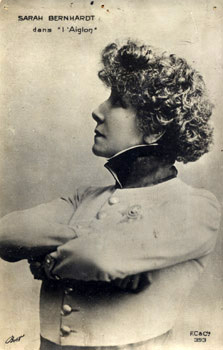
p 639 | In 1900, Sarah Bernhardt created the title role in Edmond Rostand's successful L'Aiglon. Jean-Sully Mounet (1841-1916), called Mounet-Sully, played Oedipus in the Roman arena at Orange (not Nîmes).


p 640 | ...contre-de-quartes reminiscent of Molière: referring to the fencing lesson in Le Bourgeois gentilhomme, a contre-de-quarte is a circular parrying movement of the sword.
 
p 643 | Mazagran = coffee laced with rum; gloria = a mixture of sweet coffee & rum or eau-de-vie.  Eugène Marin Labiche, French dramatist, 1815-88.  Os homini sublime dedit coelumque tueri:  "He has given man a face turned toward the sky," a line from Ovid's Metamorphoses.


p 644-45 | ...Archangel Raphael ... Tobias: this story is in the book of Tobit, in the Apocrypha.

p 657 | Verjuice = the juice from unripe grapes.


p 659 | Constant Coquelin, known as Coquelin aîné, a well-known actor (1841-1909).

p 660 | The Société des Bibliophiles Français was founded in 1820 of mainly aristocrats; the Union Club was founded in 1828 and was the most exclusive Paris club during the Second Empire.

p 661 | The Montgomery & Pembroke families were associated, as were the Chandos family & the Buckinghams. A Capel became Count of Essex in 1661, and Proust knew Berthe Capel in Paris. The Duc de Berry (1844-1910) was a member of the Orléans family.   

p 661 | Émilienne d'Alençon (Émilienne Andrée) was a celebrated courtesan around 1900, who dabbled in music & poetry & appeared with performing rabbits at the Folies-Bergère.

>p 661 | Ne sçais l'heure = I don't know the hour (of my death). It's pronounced like the name Saylor.

p 662 | Jean-Alexis Périer (1869-1954) created the role of Pelléas in Debussy's opera in 1902.  The Théâtre du Gymnase specialized in comedy; La Châtelaine was a comedy by Alfred Capus (1858-1922), a dramatist & journalist who was elected to the Académie Française in 1914.  Simone Frévalles, actress in La Châtelaine , as well as the company at the Théâtre de la Porte-Saint-Martin.  Marie Magnier (1848-1913) made her debut in 1867 and played in many Paris theaters; Louis Baron (1870-1939), known as Baron fils to distinguish him from his actor father, was a well-known comic actor at the turn of the century.

p 663 | Yvette Guilbert (1867-1944) began her celebrated career as a chanteuse around 1885. Ernest Cornaglia (1834-1912), an actor who joined the company at the Théâtre de l'Odéon in 1880; Émile Dehelly (1871-1969) debuted at the Comédie-Française in 1890.

N.B. All entries based primarily based on Sturrock's notes.

3.06.2016

Sodom and Gomorrah IV pp 611-625

p 612 | "Esther heureuse...": the titles of three of the four sections of Splendeurs et misères des courtisanes.

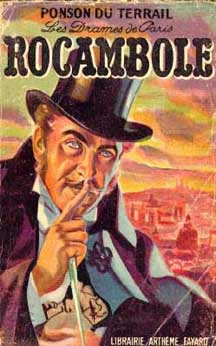
p 612 | Rocambole was the hero of more than 30 adventure novels written by Alexis Ponson du Terrail (1829-71), as well as later writers. The adjective rocambolesque usually means a fantastic adventure.

p 612 | "...moult sorbonagre, sorbonicole et sorboniforme...": a scathing Rabelaisian way of referring to a pedantic doctor from the Sorbonne, perhaps translatable as "Sorbonnified, Sorbonniculous, and Sorbonniform."

p 612 | "The quart d'heure de Rabelais...": popular phrase meaning "the moment of reckoning." An explanatory  anecdote  from a comic incident from the writer’s life. "One day he was in Lyon and wanted to travel to Paris. He had no money and so he marked several sachets of sugar “Poison for the King” and left them lying prominently around. He was arrested and taken to Paris, thus getting a free ride. King Francis I laughed so hard when he heard about it that he happily paid for the trip." Literally, "the quarter-hour of Rabelais," which is amusingly echoed in Andy Warhol's "15 minutes of fame."

p 613 | "Chateaubriand aux pommes": Sturrock says this is "Chateaubriand steak served with apple," but I think the dish is really served with potatoes (pommes frites, pommes de terres...).

p 613 |  gnōthi seauton : Greek for "Know thyself."

p 613 | Jean-Martin Charcot, 19th century French neurologist.

p 614 | "...holy terror Ovid..." Ovid wrote "Materiam superabat opus" (Metamorphoses II, 5), or "The workmanship surpassed the material" (form over content).

Hanska by Delmont
p 614 | "Meudon... ": Meudon, now part of Paris, was the parish of which Rabelais was the curé; Ferney was the Genevan home of Voltaire; the Vallée-aux-Loups, near Sceaux, was where Chateaubriand lived for several years; Les Jardies was the name of Balzac's house in Villa d'Avray; the "Polish woman" was Mme Hanska, whom Balzac married in 1850, shortly before his death and the inspiration for many of his characters. (Sturrock)

p 614 | Hippolyte Taine complained in a well-known essay on Balzac, that the Comedie humaine contained too much that was morbid or unnatural, and did not meet his literary concepts of   "race, milieu, et moment." See his Wiki page for an interesting explanation.

p 617 | Zénaïde, French form of Zenaida, a feminine form of "Zeus."

p 618 | Diane de Maufrigneuse, main character in Balzac's novel Les Secrets de la Princesse de Cadignan, part of the Comedie humaine. 

p 620 | "cut a dash" = (Br.) Be stylish or impressive in one’s dress or behavior, e.g. "The Foreign Secretary wanted to cut a dash in Brussels."

p 620 | Paul Thureau-Dangin (1837-1913) was a Catholic historian, member of the Académie française. Gaston Boissier (1823-1908) was a French classical scholar, and secretary of the Académie française.

p 620 | Boissier is a chocolatier, founded in 1827.

p 621 | ...40bis Boulevard Malesherbes...: For most of his life (until 1900) Proust lived at 9 boulevard Malesherbes, near the Madeleine church, where the family moved in 1873 after his brother Robert was born. Proust himself had lived with his parents at 9 Boulevard Malesherbes.  His maternal grandparents lived at 40bis rue du Faubourg-Poissonniere.

p 621 | Marc-Joseph-Edgar Bourdon Vatry (baron de, 1828-1891)

1.31.2016

Sodom and Gomorrah IV pp 542-62


p 543 | cabinet puddings (diplomats) = biscuits soaked in rum or kirsch. See a recipe here.  (Sturrock)

p 549 | La Sanseverina is the spirited, sophisticated heroine of Stendhal's novel La Chartreuse de Parme. (Sturrock)

p 551 | "the Baronne de Rothschild" rose named in 1868 after Laure, wife of Baron Alphonse de Rothschild; "the Maréchale Niel" (actually "Maréchal Niel") pear named in 1864 after Adolphe Niel (1802-69). (Sturrock)

p 555 | Camille Stamati (1811-70), pianist and composer, and teacher of Saint-Saens.


bon Chrétien
p 556-57 | La Comtessed'Escarbagnas is a one-act comedy by Molière, in which the heroine is sent some bon Chrétien pears as a love offering by her suitor, M. Thibaudier. The other pear names that follow came from Elisabeth (not Emilie) de Clermont-Tonnerre’s cookbook, Almanach des bonnes choses de France (1920). (Sturrock)

p 562 | Calvados brandy

12.31.2015

Diplomate au Kirsch

"Serve It Forth," by M.F.K. Fisher (North Point Press, 1989; copyright 1937 by M.F.K. Fisher)

For 8 or 10 people

  1. Cut 8 small dry sponge biscuits into half-inch cubes. Into slightly smaller cubes, cut a scant half-pound of fruits candied in syrup. 
  2. Soak the fruits in kirschwasser for 30 minutes. Drain them, and moisten the biscuit cubes with the same kirsch.
  3. Whip 3 cups of cream, sweet and very cold. When it is whipped, season it with powdered sugar and add a little vanilla flavor.
  4. Put the whipped cream, the biscuits, and the candied fruits into a mould and mix them well. Cover the mould with a sheet of white paper and seal with its cover. (Be careful to butter the lip of the mould under the paper, so that salt will not make itself a part of the composition.)
  5. Then put the mould for 2 hours into ice, finely chopped and very salty--about 2 pounds of salt to 10 of ice.

The Liquid Cream to Pour Over the Diplomate when It is Taken from the Mould Just Before Serving
  1. Into a double-boiler stir 1 full cup of milk, 2 egg yolks, 1/4 cup of powdered sugar, and 1 teaspoon of fine flour.
  2. See that the mixture does not boil, and when it thickens take it from the stove. Then perfume it amply with kirsch.
  3. Let it get very cold (either on the window-sill in winter or in summer, in the ice chest), and pour it over the Diplomate and serve at once.

9.29.2015

Sodom and Gomorrah IV pp 456-70

p 456 | Banat;  Louis d'Harcourt; Jean Anthelme Brillat-Savarin, 1755-1826): French lawyer and politician, who gained fame as an epicure and gastronome; sibylline = referring to certain women of antiquity reputed to possess powers of prophecy or divination; a female prophet or witch.

p 457 | Piquet=an early 16th-century trick-taking card game for two players. The river Dives runs through Cabourg (Balbec), this is the church by the river, Notre Dame de Dives sur mer.

p 459 | daubing: to coat or smear (a surface) with a thick or sticky substance in a carelessly rough way. 

p 459 | Paul César Helleu (1859-1927): French oil painter, pastel artist, drypoint etcher, and designer, best known for numerous portraits of beautiful society women of the Belle Époque. He also conceived the ceiling mural of night sky constellations for Grand Central Terminal in NYC. Father of Jean Helleu, grandfather of Jacques Helleu, both artistic directors for Parfums Chanel. 
Jouy

p 460 | French strawberry mousse recipe.

p 463 | See a summary of these pages here, with comments.
 
p 466 | "a piece of green lustre plugging a broken pane...": a drop-shaped piece of cut glass or crystal used as a decoration on a chandelier, vase, etc. Or, a shiny metallic surface on some pottery and porcelain.

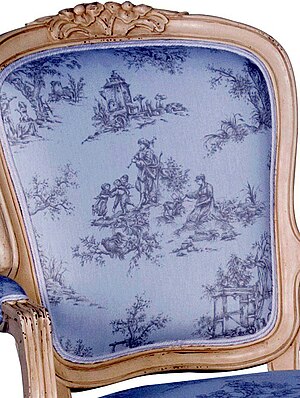
p 467 | Jouy hangings=toile de Jouy: cloth or canvas for painting on. draught-curtains are used to prevent heat loss from a room, due to drafts or weather. 

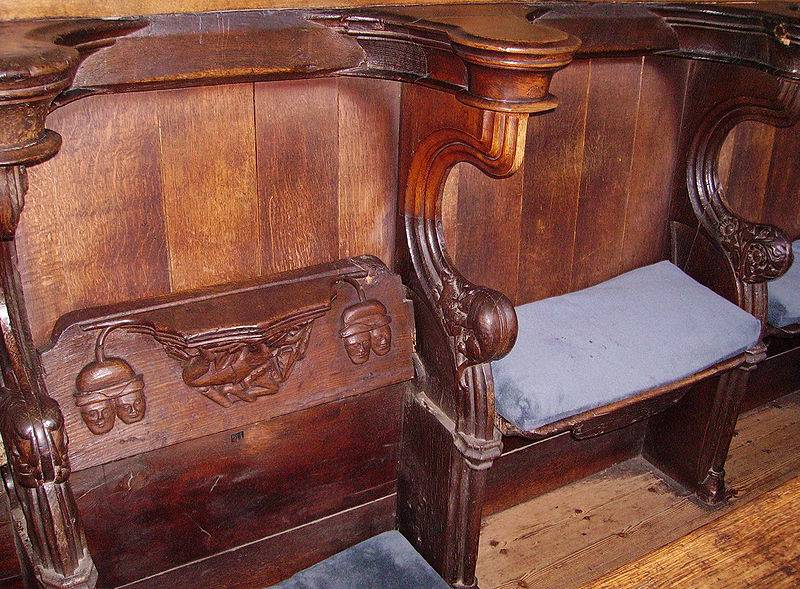
p 468 | A misericord (sometimes named mercy seat) is a small wooden shelf on the underside of a folding seat in a church, installed to provide a degree of comfort for a person who has to stand during long periods of prayer. The small shelves were available for use at times when the folding chair was required to be stored folded up, and the person expected to be in an upright position.
"Boston Stump misericord 02" by Immanuel Giel (Own work). Public Domain via Commons License
 p 468 | Agraphia: loss of the ability to write.

p 470 | "this Hohenzollern ... : with the abdication of Wilhelm II in 1918, the Hohenzollern dynasty of German emperors came to an end. The short-lived kingdom of Hanover was annexed by Prussia in 1866, and its last King was indeed dispossessed, but by Kaiser Wilhelm I, not his son. Prussia annexed Alsace-Lorraine from France following its victory in the 1870 war. (Sturrock)


9.10.2015

Sodom and Gomorrah IV pp 397-446

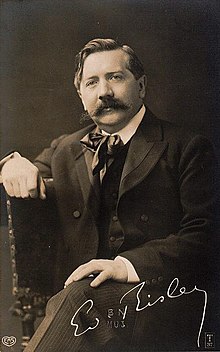
p 401 | Francis Planté (1839-1934), French pianist; Ignacy Jan Paderewski (1860-1941), a virtuoso pianist who twice became prime minister of his native Poland; Édouard Risler (1873-1929), a French pianist best known for his playing of Liszt and Beethoven. 

p 401 | "Qualis artifex pereo!": "What an artist perishes in me!," supposedly the Emperor Nero's last words. German classicists had been unable to agree on the worth or authenticity of the Latin poetry attributed to him. 

p 407 | Demoiselles de Caen (lobsters) are small Normandy lobsters; Pampille was the pen name of Mme Marthe Daudet, who wrote cooking & fashion columns in the right-wing paper L'Action run by her husband, Proust's friend Léon.

p 409 | Pierre de Ronsard (1524-85), greatest of French Renaissance poets. His popularity and prosperity in his own time was steady.   


p 411 | buen retiro: Spanish phrase literally meaning "good retreat", used here meaning toilet.

p 411 | An eminent publisher ... paper knife: possibly a description of Eugene Fasquelle, a Paris publisher known to Proust.

p 419 | Jean-Gilbert-Victor Fialin, Due de Persigny (1808-72), was a right-wing politician who became minister of the interior and ambassador to London under the Second Empire.

p 421 | Dumas fils was Alexandre Dumas (1824-95),  novelist & playwright, son of Alexandre Dumas, the novelist of the same name, best known as the author of La Dame aux camelias.

p 424 | Cancan: the word can refer to either an item of unkind gossip, or the quack of a duck. (mid 19th century: from French, a child's word for canard ‘duck,’ from Old French caner ‘to quack.’ The name can-can may be derived from the French for tittle-tattle or scandal. However the dance was also called the coin-coin, which could have become corrupted into can-can.

p 427 | Jean de La Fontaine (1621-95),  the  greatest  of French  fabulists; Jean-Pierre Claris de Florian (1755-94), Voltaire's great-nephew and, as a writer of fables, much influenced by Rousseau.

p 427 | Julien de Monchateau ... "Pico della Mirandola": Francois de Monchateau was celebrated in France as a child prodigy (as was Pic0 della Mirandola in Renaissance Florence).

p 429 | Place Saint-Sulpice: where, in Paris, the cheapest and most tasteless religious objects can be bought.

p 430 |  Ferdinand Barbedienne (1810-92) specialized in casting bronze reproductions of classical statuary, popular with 19th-century bourgeoisie.

p 434 | Harpagon: the sexagenarian bourgeois miser in Molière's comedy L'Avare (The Miser).

p 434-37 | "Chantepie ... Does it deserve its name?": une pie is "a magpie," chanter means "to sing," so that the name should refer to a place where magpies sing.

p 438 | Jules Lachelier (1832-1918), French idealist philosopher, wrote influentially about the problem of induction, and is opposed here to John Stuart Mill, a philosopher known
in France in Proust's day as an extreme empiricist.


p 438 | Jean-Francois Millet (1814-75), celebrated for painting scenes of peasant life, notably the much reproduced L'Angelus.

p 439 | Chantereine: play on words... chanter, to sing and reine means "queen."

p 440-41 | Pont-a-Couleuvre would literally mean "Snake Bridge" or “Serpent bridge,” which was formerly Pont-à-Quileuvre, which in old French stands for Pont a qui l'euvre, in Latin Pons cui aperit, i.e., Pont a qui ouvre, closed bridge opened only upon payment.


p 441 | In none of La Fontaine's or Florian's fables does a frog find itself before the Areopagus, or supreme court of Athens.

p 443 | " 'She has good qualities ...'": the quotation from Mme de Sévigné, modified by Proust, refers to her daughter-in-law.

p 446 | Members of the French Senate, like Charles de Freycinet (1828-1923) and Justin de Selves (1848-1934). Sylva = Latin word for a wood.

p 447-48 | The Tour d'Argent, on the Left Bank, was, and is, one of the great restaurants of Paris; the Hotel Meurice, on the rue de Rivoli, was one of the city's best in Proust's day.  Emile Boutroux (1845-1921) taught philosophy at the Sorbonne, and at one time had Henri Bergson for a pupil. 

p 448-49 | The Forty are the "Immortals," or the 40 members of the Academie Francaise. Not all the names Brichot cites were actual Academicians.

p 449 | Paul Parfouru (1842-1917) was called Porel. He was an actor & theater director, who ran the Odéonon theater from 1884 to 1892, hence the reference to "Odeonia"; his son, Jacques Porel  (1893-1982), was a friend of Proust's.

p 449-51 | "...two trees...": Saint-Martin-du-Chene (un chene is an oak tree) & Saint-Pierre-des-Ifs (un if is a yew tree).


Place Saint-Sulpice

N.B. All entries based primarily based on Sturrock's notes.

4.27.2014

The Guermantes Way III p 685-703

p 685 | Attic salt: Refined, delicate wit.

p 686 | Maecenas - a generous patron especially of literature or art. Latin, from Gaius Maecenas 8 b.c. Roman statesman & patron of literature.


p 687 | Jehan George Vibert, Academic painter, 1840-1902.

p 688 | Pampille... was Marthe Daudet (1878–1960).

p 690 | Antoinette Élisabeth, Duchess of Clermont-Tonnerre (née de Gramont; 1875-1954), French writer, close friend, sometimes critic, of Proust, whom she met in 1903. 

p 690 | Ortolan's eggs.

p 692 | Jacques-Bénigne Bossuet(1627–1704), French bishop & theologian, known for his sermons & other addresses, is sometimes considered one of the most brilliant orators of all time & a masterful French stylist.

p 692 | François Coppée (1842–1908): French poet and novelist.

p 693 | Mme Alphonse de Rothschild=Leonora "Laure" de Rothschild (1837-1911)

p 697 | La Dame aux camélias: 1848 novel by Dumas fils, made into Camille and La Traviata.
Apostle

p 698 | Sic transit gloria mundi is a Latin phrase that means "Thus passes the glory of the world."
p 698 | Le malade imaginaire (The Imaginary Invalid, 1673), a 3-act comedy/ballet by Molière & Marc-Antoine Charpentier.

p 699 | Queen of Naples=Maria Sophie of Bavaria, sister of Elisabeth, Empress of Austria.

p 700 | Queen of Sweden=Sophia of Nassau.

p 702 | Apostles in the Sainte-Chapelle.
p 702 | Yquem: Sauterne wine.

p 703 | Orangeade (recipe); stewed cherries (recipe), stewed pears (recipe)

3.29.2014

The Guermantes Way III p 626-629

p 627 | squaring the circle: which was proven impossible in 1882; the expression is often used as a metaphor for trying to do the impossible
p 627 | minced pork of Tours: perhaps referring to these rillettes; biscuits of Rheims, which are pink. <<==


p 628 | conical mitre of the Jews: the Jewish hat <<==
p 628 | Academic robe ==>>
p 628 | pharisaical = marked by hypocritical censorious self-righteousness
p 628 | aroma of carbolic acid: Phenol — also known as carbolic acid - is an aromatic organic compound, once was widely used as an antiseptic, especially as carbolic soap, from the early 1900s to the 1970s.
p 628 | <<==  gown of scarlet satin faced with ermine, like that of a Doge...
p 629 | The Council of Ten (1310-1797), one of the major governing bodies of the Republic of Venice.
p 629 | Veto: from the Latin vetare, I forbid.
p 629 | Juro: While playing the hypochondriac Argan in his last play Le Malade Imaginaire (The Imaginary Invalid), Molière, who suffered from pulmonary tuberculosis, was seized by a coughing fit & spat blood just before he was to speak the word Juro (I swear). He finished the performance and died a few hours later.
p 629 | Bar Council: Bar Association.
p 629 | Chargé d'affaires = diplomatic official who temporarily takes the place of an ambassador.
p 629 | Salon=The Salon or Salon de Paris, beginning in 1725, was the official art exhibition of the Académie des Beaux-Arts in Paris. From 1748-1890, it was the greatest annual or biannual art event in the Western world. In 1849, medals were introduced.

7.08.2010

Notes from week 37: Foreign Policy from Norpois

CAMARILLA: \kam-uh-RIL-uh; -REE-yuh\ , noun;
1. A group of secret and often scheming advisers, as of a king; a cabal or clique.
Origin: Camarilla comes from Spanish, literally, "a small room," from Late Latin camera, "chamber" ("vault; arched roof" in Latin), from Greek kamara, "vault."
Quote: "Mr Kiselev likened Yeltsin's entourage to a "camarilla" . . . which would turn Russia "into a gigantic banana republic corrupted from top to bottom by a rotten clique of demagogues". -- Marcus Warren, "Moguls at war over control of Kremlin", Daily Telegraph, July 23, 1999
HISTORY
  • During the Siege of Paris in 1871, the northern German states, supported by its German allies from outside of the confederation (excluding Austria), formed the GERMAN EMPIRE with the proclamation of the Prussian king WILHELM I of Prussia as German Emperor in the Hall of Mirrors at the Palace of Versailles (note: he was the grandson of Queen Victoria of England!).
  • The French term Entente-Cordiale ("cordial agreement") (amities?) was first used in English in 1844 (OED) to denote recognition of common interests between the United Kingdom & France. When used today, it almost always denotes the 2nd Entente-Cordiale, the written and partly secret agreement signed in London between the two powers on 8 April 1904.
  • The Franco-Russian Alliance was a military alliance between the French Third Republic and the Russian Empire that ran from 1892 to 1917. The alliance ended the diplomatic isolation of France and undermined the supremacy of the German Empire in Europe.
  • More on FRANCE in the 19th CENTURY  
~~~~~~~~~~
“What do I see? A Nesselrode pudding! As well! I declare, I shall need a course at Carlsbad after such a Lucullus-feast as this."

Recipe for and photos of Nesselrode Pudding...  "Flavored with chestnuts and maraschino, Nesselrode pudding was a Victorian favorite."

^^ CARLSBAD was/is a spa in Bohemia (current Czechoslovakia)

Lucullan  [loo-kuhl-uhn]  –adjective
1.(esp. of banquets, parties, etc.) marked by lavishness and richness; sumptuous.
2. of or pertaining to Lucullus or his life style. Also, Lu·cul·le·an  [loo-kuh-lee-uhn]   Lu·cul·li·an.  Origin: 1855–60;  < L Lucullanus; see Lucullus

"Lucullan." Dictionary.com Unabridged. Random House, Inc. 08 Jul. 2010. http://dictionary.reference.com/browse/Lucullan>.

demi-monde - Marges de la bonne société, mais fréquentées par celle-ci. (En particulier) Milieu constitué autour de femmes légères, souvent vénales ou entretenues par les hommes du monde fr.wiktionary.org/wiki/demi-monde


Demi-mondaine was a polite 19th century term that was often used the same way we use the term "mistress" today. Demi-monde primarily referred to a class of women on the fringes of respectable society supported by wealthy lovers (usually each had several)...  en.wikipedia.org/wiki/Demimonde