Pages

Showing posts with label Quotes. Show all posts

10.30.2016

The Captive V pp 169-210


p 176 | Gregory the Great . . . Palestrina: Gregory the Great, Pope from 590 to 604, is supposed to have set the rules for Gregorian chant. A 16th-century Pope, Gregory XIII, had Palestrina adapt the old chants to the new liturgy of Pius V. (Clark)

p 180 | Charles de Sévigné, son of Madame de Sévigné.

p 185 | Les Fourberies de Nérine, a comedy in verse by by Théodore de Banville


p 195 | Danaides . . . Ixion: From Greek legend, they were condemned to never-ending tasks. The Danaides (the 50 daughters of Danaus) murdered their husbands and were condemned to spend eternity pouring water into a bottomless vessel. Ixion was attached by Zeus to a burning wheel which turned eternally in the Underworld.

p 196 | Trois Quartiers shop in Paris.

p 203 | midinette : Parisian seamstress or salesgirl in a clothes shop (French, from midi [noon] + dinette [light meal], since the girls had time for no more than a snack at midday). © Collins English Dictionary,, 12th ed, 2014

p 205 | Lamoureux concert = an orchestral concert society which once gave weekly concerts by its own orchestra, founded in Paris by Charles Lamoureux in 1881.

p 205 | The Longjumeau Postilion: An 1836 comic opera by Adolphe Adam. In 1915, the critic Frederic Masson wrote that this work compared to Wagner's Die Meistersinger.

p 207 | Human Comedy (title of Balzac's collected novels); The Legend of the Centuries (a collection of narrative poems by Victor Hugo); The Bible of Humanity (imaginative attempt at a synthesis of human history by Jules Michelet)

p 210 | 120 hp Mystère : a make of aircraft.

p 210 | L 'Education sentimentale: in Flaubert's novel of that name, the woman the hero loves sees in his house a portrait of a former mistress of his, whom she had known. She says, "I've seen that woman somewhere," but he replies, "Impossible, it's an old Italian painting."

10.28.2016

The Captive V pp 147-156

p 147-49 | "Boris Godunov . . . Pelléas":  Mussorgsky's opera Boris Godunov was first performed in Paris in 1908, Debussy's Pelléas et Melisande in 1902, but Proust first heard them in 1911-13, when he was first working on The Captive.  The novelty of these music-dramas was that they did not observe the old operatic distinction between recitative and aria, but were through-composed (songs composed without repetitions, i.e., using different music for each verse), their essential dialogue delivered with only small variations of pitch. (Clark)

In Pelléas et Mélisande, instead of a librettist adapting the original play for him, Debussy chose to set the text directly, since Maeterlinck's play was in prose rather than verse. This contributes to the most famous feature of the opera: the almost complete absence of arias or set pieces... Instead, Debussy set the text one note to a syllable in a "continuous, fluid 'cantilena', somewhere between chant and recitative". (Wikipedia)

p 148 | Jean-Phillipe Rameau: these words appear in Phillipe Quinault's libretto Armide, set to music first by Lully in 1686 and then by Gluck in 1777  (not in an opera by Rameau, as Proust seems to have thought).  (Clark)

p 149 | "...Arkel . . .  Golaud ...  the King of Allemande...":  characters in Pelléas et Melisande. (Clark)

p 149 | Per omnia saecula saeculorum = for ever and ever, through all ages of ages, world without end; Requiescat in pace = May he/she rest in peace. Both phrases conclude prayers for the dead, both usually intoned with the last syllable falling a minor third, and followed by "Amen." (Clark)

p 149 | Cerement= Usually plural: a waxy cloth used for wrapping the dead, or any burial garments (Hamlet, act 1, sc 4)

p 150 | Costermonger: a person who sells goods, especially fruit and vegetables, from a handcart in the street.

p 150 | Antiphonary=one of 3 liturgical books used for the Divine Office (the others being the breviary & the choir psalter). The antiphonary contains, among other elements, antiphons, which are short sentences sung or recited before or after a psalm or canticle. Antiphonaries are fairly large so they are easily read by all members of a choir.  Trivium= the lower division of the 7 liberal arts:  grammar, logic, and rhetoric (input, process, and output).  Subjects of the trivium are the foundation for the quadrivium, the upper division of the medieval education in the liberal arts, which comprised arithmetic (number), geometry (number in space), music (number in time), and astronomy (number in space and time). Educationally, the trivium and the quadrivium imparted to the student the 7 liberal arts of classical antiquity. 


Basque beret
  Tinker = (especially in former times) a person who travels from place to place mending metal utensils as a way of making a living.

 p 152 | "What insolent mortal comes to meet his doom?" "Was it for you this stern decree was made?" "In you alone, a certain grace I see/That always charms and never wearies  me." (Lines from Esther by Racine).  (Clark)

p 155 | Hippolyte Taine (1828–93): critic and historian, who had a profound effect on French literature.  George Eliot, pseudonym of Mary Ann Evans (1819-80): English Victorian novelist who developed the method of psychological analysis characteristic of modern fiction.

p 156 |  Mnemotechniaa goddess not only of memory (time past) but of method (technia): she offers a way of remembering and recording the passage of time. (Ellen Eve Frank, Literary Architecture)

5.12.2016

The Captive V pp 1-27

p 3 | Russian ballet=Ballets Russes

p 3 | "Les douleur sont des folles/Et qui les écoute est encore plus fou."  Albertine hums this refrain from Biniou, by Hippolyte Guérin, music by Emile Durand (1830-1903). 

p 4 | "Une chanson d'adieu sort des sources troublées..."  From Pensée d'automne by Armand Silvestre, music by Jules Massenet, French opera composer, 1842-1912.

p 13 | Assuerus = Ahasuerus, King of Persia, in the play Esther, by Racine., here Act I, Scene 3


p 15 | Parc des Buttes Chaumont: 5th largest park in Paris, opened in 1867. The park took its name from the bleak hill on the site, which, because of the soil's chemical composition, was almost bare of vegetation; it was called Chauve-mont, or bare hill.

p 16 | coalheaver = one who feeds coal into a furnace

p 20 | Gomorrah: Sodom and Gomorrah were cities named in the Bible, the Torah and other religious texts, destroyed by God in fire and brimstone because of their lack of hospitality & wickedness. Proust here seems to be using it to refer to the  rampant lesbianism he imagined at Balbec.

 p 27 |  Arquebus : an early muzzle-loaded firearm, sensitive to humidity.

4.07.2016

Sodom and Gomorrah IV pp 639-662

p 638 | Tantus ab uno splendor = Such brilliance coming from one person. 

p 639 | Mort m'est vie = Death, to me, is life.


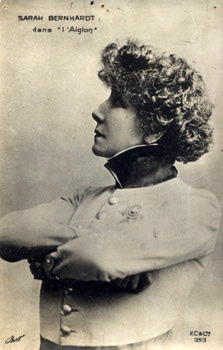
p 639 | In 1900, Sarah Bernhardt created the title role in Edmond Rostand's successful L'Aiglon. Jean-Sully Mounet (1841-1916), called Mounet-Sully, played Oedipus in the Roman arena at Orange (not Nîmes).


p 640 | ...contre-de-quartes reminiscent of Molière: referring to the fencing lesson in Le Bourgeois gentilhomme, a contre-de-quarte is a circular parrying movement of the sword.
 
p 643 | Mazagran = coffee laced with rum; gloria = a mixture of sweet coffee & rum or eau-de-vie.  Eugène Marin Labiche, French dramatist, 1815-88.  Os homini sublime dedit coelumque tueri:  "He has given man a face turned toward the sky," a line from Ovid's Metamorphoses.


p 644-45 | ...Archangel Raphael ... Tobias: this story is in the book of Tobit, in the Apocrypha.

p 657 | Verjuice = the juice from unripe grapes.


p 659 | Constant Coquelin, known as Coquelin aîné, a well-known actor (1841-1909).

p 660 | The Société des Bibliophiles Français was founded in 1820 of mainly aristocrats; the Union Club was founded in 1828 and was the most exclusive Paris club during the Second Empire.

p 661 | The Montgomery & Pembroke families were associated, as were the Chandos family & the Buckinghams. A Capel became Count of Essex in 1661, and Proust knew Berthe Capel in Paris. The Duc de Berry (1844-1910) was a member of the Orléans family.   

p 661 | Émilienne d'Alençon (Émilienne Andrée) was a celebrated courtesan around 1900, who dabbled in music & poetry & appeared with performing rabbits at the Folies-Bergère.

>p 661 | Ne sçais l'heure = I don't know the hour (of my death). It's pronounced like the name Saylor.

p 662 | Jean-Alexis Périer (1869-1954) created the role of Pelléas in Debussy's opera in 1902.  The Théâtre du Gymnase specialized in comedy; La Châtelaine was a comedy by Alfred Capus (1858-1922), a dramatist & journalist who was elected to the Académie Française in 1914.  Simone Frévalles, actress in La Châtelaine , as well as the company at the Théâtre de la Porte-Saint-Martin.  Marie Magnier (1848-1913) made her debut in 1867 and played in many Paris theaters; Louis Baron (1870-1939), known as Baron fils to distinguish him from his actor father, was a well-known comic actor at the turn of the century.

p 663 | Yvette Guilbert (1867-1944) began her celebrated career as a chanteuse around 1885. Ernest Cornaglia (1834-1912), an actor who joined the company at the Théâtre de l'Odéon in 1880; Émile Dehelly (1871-1969) debuted at the Comédie-Française in 1890.

N.B. All entries based primarily based on Sturrock's notes.

9.10.2015

Sodom and Gomorrah IV pp 397-446

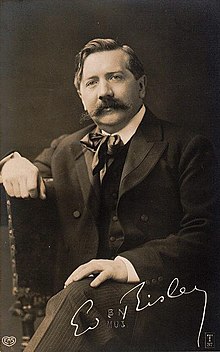
p 401 | Francis Planté (1839-1934), French pianist; Ignacy Jan Paderewski (1860-1941), a virtuoso pianist who twice became prime minister of his native Poland; Édouard Risler (1873-1929), a French pianist best known for his playing of Liszt and Beethoven. 

p 401 | "Qualis artifex pereo!": "What an artist perishes in me!," supposedly the Emperor Nero's last words. German classicists had been unable to agree on the worth or authenticity of the Latin poetry attributed to him. 

p 407 | Demoiselles de Caen (lobsters) are small Normandy lobsters; Pampille was the pen name of Mme Marthe Daudet, who wrote cooking & fashion columns in the right-wing paper L'Action run by her husband, Proust's friend Léon.

p 409 | Pierre de Ronsard (1524-85), greatest of French Renaissance poets. His popularity and prosperity in his own time was steady.   


p 411 | buen retiro: Spanish phrase literally meaning "good retreat", used here meaning toilet.

p 411 | An eminent publisher ... paper knife: possibly a description of Eugene Fasquelle, a Paris publisher known to Proust.

p 419 | Jean-Gilbert-Victor Fialin, Due de Persigny (1808-72), was a right-wing politician who became minister of the interior and ambassador to London under the Second Empire.

p 421 | Dumas fils was Alexandre Dumas (1824-95),  novelist & playwright, son of Alexandre Dumas, the novelist of the same name, best known as the author of La Dame aux camelias.

p 424 | Cancan: the word can refer to either an item of unkind gossip, or the quack of a duck. (mid 19th century: from French, a child's word for canard ‘duck,’ from Old French caner ‘to quack.’ The name can-can may be derived from the French for tittle-tattle or scandal. However the dance was also called the coin-coin, which could have become corrupted into can-can.

p 427 | Jean de La Fontaine (1621-95),  the  greatest  of French  fabulists; Jean-Pierre Claris de Florian (1755-94), Voltaire's great-nephew and, as a writer of fables, much influenced by Rousseau.

p 427 | Julien de Monchateau ... "Pico della Mirandola": Francois de Monchateau was celebrated in France as a child prodigy (as was Pic0 della Mirandola in Renaissance Florence).

p 429 | Place Saint-Sulpice: where, in Paris, the cheapest and most tasteless religious objects can be bought.

p 430 Ferdinand Barbedienne (1810-92) specialized in casting bronze reproductions of classical statuary, popular with 19th-century bourgeoisie.

p 434 | Harpagon: the sexagenarian bourgeois miser in Molière's comedy L'Avare (The Miser).

p 434-37 | "Chantepie ... Does it deserve its name?": une pie is "a magpie," chanter means "to sing," so that the name should refer to a place where magpies sing.

p 438 | Jules Lachelier (1832-1918), French idealist philosopher, wrote influentially about the problem of induction, and is opposed here to John Stuart Mill, a philosopher known
in France in Proust's day as an extreme empiricist.


p 438 | Jean-Francois Millet (1814-75), celebrated for painting scenes of peasant life, notably the much reproduced L'Angelus.

p 439 | Chantereine: play on words... chanter, to sing and reine means "queen."

p 440-41 | Pont-a-Couleuvre would literally mean "Snake Bridge" or “Serpent bridge,” which was formerly Pont-à-Quileuvre, which in old French stands for Pont a qui l'euvre, in Latin Pons cui aperit, i.e., Pont a qui ouvre, closed bridge opened only upon payment.


p 441 | In none of La Fontaine's or Florian's fables does a frog find itself before the Areopagus, or supreme court of Athens.

p 443 | " 'She has good qualities ...'": the quotation from Mme de Sévigné, modified by Proust, refers to her daughter-in-law.

p 446 | Members of the French Senate, like Charles de Freycinet (1828-1923) and Justin de Selves (1848-1934). Sylva = Latin word for a wood.

p 447-48 | The Tour d'Argent, on the Left Bank, was, and is, one of the great restaurants of Paris; the Hotel Meurice, on the rue de Rivoli, was one of the city's best in Proust's day.  Emile Boutroux (1845-1921) taught philosophy at the Sorbonne, and at one time had Henri Bergson for a pupil. 

p 448-49 | The Forty are the "Immortals," or the 40 members of the Academie Francaise. Not all the names Brichot cites were actual Academicians.

p 449 | Paul Parfouru (1842-1917) was called Porel. He was an actor & theater director, who ran the Odéonon theater from 1884 to 1892, hence the reference to "Odeonia"; his son, Jacques Porel  (1893-1982), was a friend of Proust's.

p 449-51 | "...two trees...": Saint-Martin-du-Chene (un chene is an oak tree) & Saint-Pierre-des-Ifs (un if is a yew tree).


Place Saint-Sulpice

N.B. All entries based primarily based on Sturrock's notes.

9.05.2015

Sodom and Gomorrah IV pp 372-97

p 372 | William= German Emperor Wilhelm II. 

p 373 | the Abbaye-aux-Bois: where the celebrated hostess Mme de Récamierher had her salon in Paris, at which, during the 1820s, the great Romantic writers, Chateaubriand among them, read their works in public. 

p 373 | Émilie du Châtelet (1706-49), French mathematician, physicist, and author during the Age of Enlightenment, who had a long liaison with Voltaire. 

p 373 | ... Roman Empress...: possibly Agrippina, wife of Claudius I and mother of Nero, famous for her domineering ways.  (Sturrock) 

p 373 |... like Christ or the Kaiser...: a reference to Christ's injunction in Matthew 10:37; and to Kaiser Wilhelm II's declarations of 1891 that "The will of the King is the supreme law" and that soldiers should obey "without a murmur" if ordered to fire on their own families. (Sturrock) 

p 374 | "You alone did seem ...": "Toi seule me parus ce qu'on cherche toujours." (from Vigny) 

p 378 | Pierre Potain (1825-1901), a prominent Paris medical man, with several literary patients 
(see the Goncourts' Journal); Jean-Martin Charcot (1825-93), greatest of 19th-century neurologists in France, who influenced young Freud when he was a medical student in Paris.

p 380 |the comedies of Pierre de Marivaux (1688-1763) contain numerous aristocrats, but no baronnes. (Sturrock)

p 380 | Eugene Viollet-le-Duc (1814-79) was a champion of Gothic architecture, responsible for the restoration of many medieval buildings. 

p 381 | "Charles-Maurice, Abbé of Perigord"=Talleyrand, both an unbeliever and a Catholic bishop.

p 384 | Vincent d'Indy (1851-1931), composer & teacher, was outspokenly anti-Dreyfus, and also anti-Semitic. The position of Claude Debussy (1862-1918) was more nuanced; ironically, the fiercely partisan disagreements as to the merits or otherwise of his opera, Pelléas et Mélisande , caused it later to be likened to the Dreyfus Affair.

Molière
p 386 | squireen: A person who is half squire, half farmer.  
p 387 | Henri Meilhac (1831-97) wrote plays and comic operas, the best-known of which is La belle Hélène. Brichot is referring to Pascal's famous pensée: "If Cleopatra's nose had been shorter, the whole face of the earth would have been changed." (Sturrock) 
p 393 | Jean-Baptiste Poquelin was the real name of Molière, whose absurd character Argan, in Le malade imaginaire, is the model for Proust's pastiche of medical jargon. Mr. Purgon, a character from the same play.    (Sturrock) 

p 387 | "Uncle, I mean Sarcey": Francisque Sarcey (1827-99) was the leading drama critic of the day, nicknamed "Uncle" for his good sense and middlebrow tastes.   (Sturrock)
 

p 397 | Phineas Taylor Barnum (1810-91), the archetypal American showman and publicist.

9.03.2015

Sodom and Gomorrah IV pp 357-72

p 358 | train transportation: here is a map of French railways, 1882

p 359 | pecus: Latin for "cattle, sheep, livestock."

p 361 | Emmaus: Luke's Gospel says that Jesus appeared (after his death & resurrection), before two of his disciples while they were on the road to Emmaus.

p 361 | The Sorbonne: Higher education reorganized considerably in France from 1885-96; new universal disciplines were created, often on the German model (Storrock).

p 363 | Trilby: A soft felt men's hat with a deeply indented crown and a narrow brim often upturned at the back.  Un smoking is a tuxedo or dinner jacket. Top Hat=>


p 364 | Princesse de Caprarola: a made-up title, character name; Caprarola is a city in central Italy.

p 370 | Abel-Francois Villemain (1790-1870), critic, Sorbonne professor, politician, Academician.

p 371 | douceur de vivre: the sweetness of living. Pococurantism = indifference, nonchalance, lack of concern. 

p 372 | Charles-Maurice de Talleyrand-Périgord (1754-1838), bishop, statesman, diplomat & political survivor.   

p 372 | Jean François Paul de Gondi (1613-7), Cardinal de Retz, was powerful in both the church and the state; some famous memoirs.  

p 372 | Struggle-for-lifer was an English phrase derived from the Darwinism of the late 19th century.  


Boulanger by Nadar
p 372 | The boulangistes were the supporters of Georges Boulanger (1837-91), a French general and politician, popular during the Third Republic.